
Excited State Absorption (ESA) is a device that causes the absorption of light in the excited state of atoms, ions, or molecules, rather than in their ground state. If these two conditions are met, the following things happen:
- There will be one or more higher-order energy levels at an appropriate distance above the excitation level, i.e., the photon energy will be fitted according to the wavelength of the incident light;
- Some people have different groups of excited starting levels (if they can't have a large starting level group, it's because it's very short-lived and ESA can be largely suppressed.) );
If the starting energy level is metastable, with a fairly long-lived energy level, the second condition is obviously easier to satisfy.
Adverse effects of ESA on lasers and amplifiers:
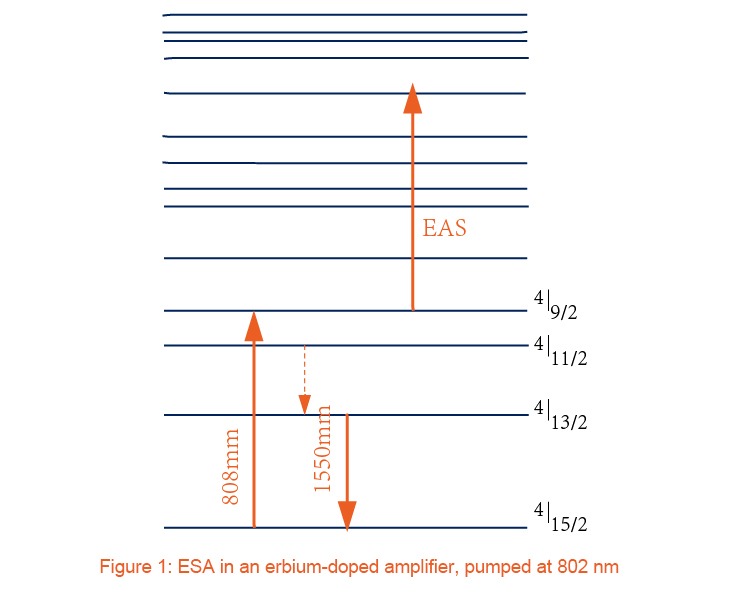 For example, in a solid-state laser gain medium, the particle population of the laser energy level is not only amplified by stimulated emission, but also by the absorption process of pump or laser radiation, in which the laser ions are excited to higher energy levels. For example, when an erbium-doped fiber amplifier is pumped with a laser diode, the 808 nm emission (Figure 1) at this wavelength not only results in the aggregation of the upper laser levels, but also uses ESA to excite the higher levels uselessly. This problem was later solved by pumping with a laser diode emitting about 975 nm, and ESA has completely avoided this problem.
For lasers, this additional loss of ESA increases the threshold pump power and decreases the slope efficiency. Of course, excited state absorption can occur not only in pump light, but also in laser or signal light. As a result, it can reduce the gain and efficiency of the amplifier in certain signal wavelength ranges, or cause the laser to operate at different wavelengths, largely evading the absorption of excitation dwells.
ESA is a common problem, especially for broadband laser gain media, such as transition metal-doped crystals, but for rare-earth-doped crystals, the bandwidth transition is relatively narrow. Of course, ESA is more likely to be associated with laser ions of this multiple electron level, e.g. erbium or thulium, and certainly not to ytterbium.
ESA is also common in saturable absorbing materials, such as Cr4+:YAG, where the ground-state absorption is completely bleached, but even at fairly high light intensities it remains in the excited state absorption, which recovers more rapidly. But in practice, ESA causes unsaturated losses (at least for nanosecond pulses), which can account for a large portion of the saturation losses.
ESA in an upconversion laser

- Of course, this in Figure 2 allows for the construction of a blue (480 nm) upconversion laser. Short gray arrows indicate multi-phonon transitions.
- Although excited-state absorption is detrimental in most cases, it can also be used in upconversion pumps, where higher energy levels need to be excited. This is utilized in some thulium-doped lasers (Figure 2) as well as other upconversion lasers. Of course, in addition to the lifetime of the intermediate energy level, the rate equation model also needs the value of the ESA cross-section.
Calculate the impact of the ESA
In some cases, it is relatively straightforward to include an ESA in a laser model. For example, a pump or signal ESA may simply result in an additional absorption term, and if the ESA directs ions to a level, from there they quickly relax to the upper laser level. In more complex cases, the horizontal scheme of Thulium can be modeled using the rate equation.
Measurement of ESA cross-sections
The measurement of excited state absorption is more difficult than that of ground state absorption. A common technique is based on the use of a modulated pump beam to monitor the transmission of the sample with a monochromator, a photodetector, and a lock-in amplifier while the electron level creates the modulated population. The resulting spectra show differences in laser gain and ESA, but may also contain contributions from other levels.
Be the first to comment