
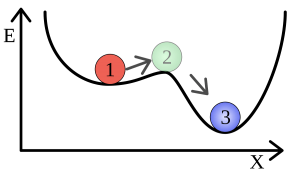
Explanation of metastable terms: Some atoms have some energy levels of special excited states, and when atoms are on the energy levels of these excited states, they can stay for a relatively long time, which is more than 100,000 times longer than the time in the general excited state, and this special excited state is called "metastability". There are many atoms with metastable states like neon, neodymium, etc.
Metastable states are excited states, such as those of atoms or ions, that have a relatively long lifetime and produce only weak spontaneous emissions. And in many cases, an excited atom jumps to one of its low-energy states by spontaneous radiation within a few nanoseconds, but in some cases this transition is "forbidden" (or "faintly generated") because certain symmetries prohibit the interaction of the dominant dipole with the electromagnetic field. In this case, spontaneous emission can only be based on a more complex process, and as a result, the level life can be much longer than usual, for example, in milliseconds instead of nanoseconds.
Metastability of a solid-state gain medium
Solid-state gain media usually have upper-level electrons with metastable lifetimes and often have some incidental metastability (energy levels). The life of the upper energy level, that is, the life of the upper laser energy level, can be microseconds or even milliseconds. For example, it is typically about 8-10 ms for erbium-doped fiber amplifiers or 1-2 ms for ytterbium-doped laser gain media.
In solid-state media, weak spontaneous emissions are not the only condition for long energy level lifetimes; In addition, it is required that there are no substantial non-radiative transitions, such as in the form of multiphonic transitions or quenching caused by certain impurities.
Be the first to comment