
Marking principle
Laser coding
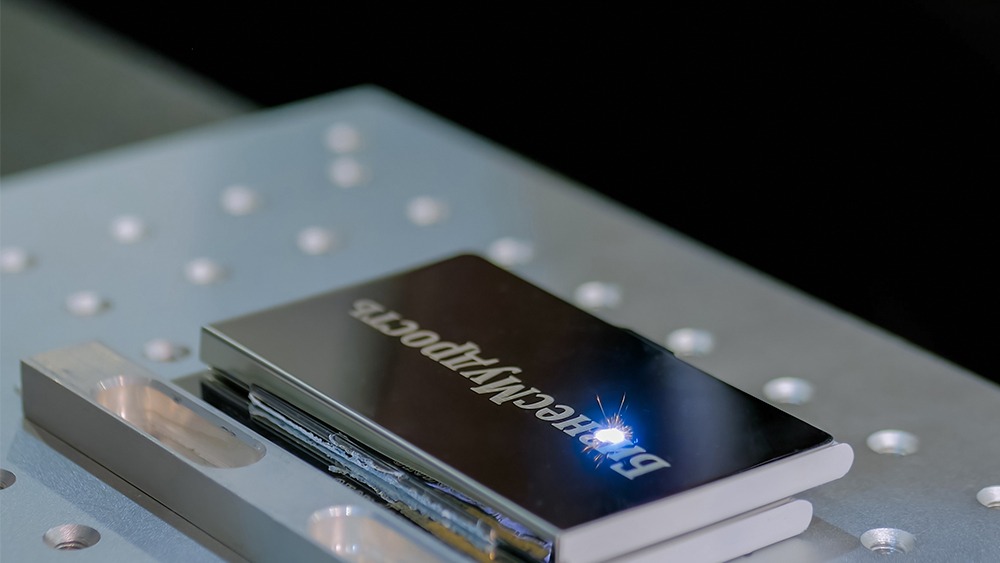
Anneal
Marking material: ferrous metal (iron, steel) titanium
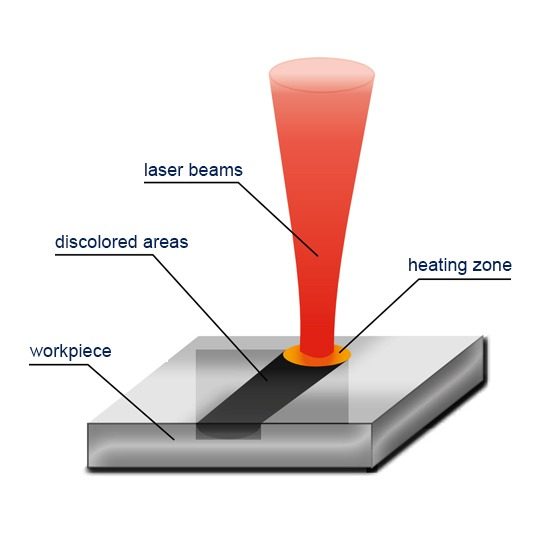
Annealing marking refers to the formation of oxide layers on ferrous metals (iron, steel, high-quality steel) and titanium by local heating.
Laser annealing is a labeling technique that uses laser irradiation heat to induce local oxidation without significant material ablation. The process produces a permanent black mark that cannot be erased without any cracks, dents or burrs, and is suitable for finished surfaces such as surgical instruments and tools with high surface accuracy.
Links to related content
- Lasers are recommended
- List items #2
- List items #3
Carve
Marking materials : metal, thermoplastic, paper, wood, organics
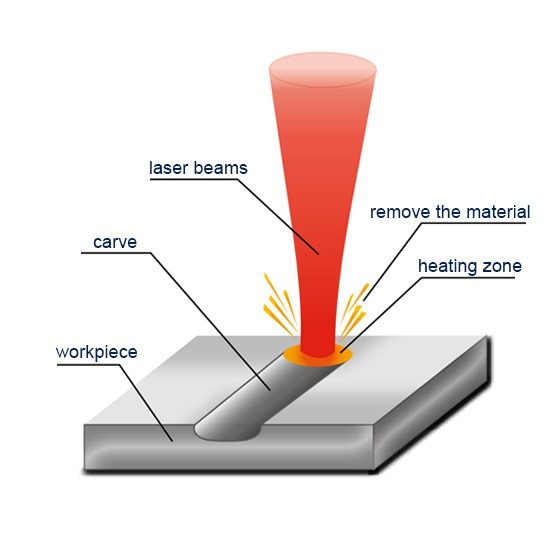
In the case of engraving using laser marking, the material is removed or removed from the surface of the element to be processed. This can be achieved on almost all materials.
In particular, metals, plastics, and ceramics are engraved using laser marking machines. The laser beam penetrates the surface and removes it, creating a visible depression of up to 50 μm in the area.
Since the material is heated at the same time and reacts with the surrounding air, discoloration often occurs in the engraved area, which is more prominent due to the marking.
Links to related content
- List items #1
- List items #2
- List items #3
Etch
Marking Material : Metal
The laser etching process involves the use of laser irradiation to alter the surface finish of the metal and create contrast by enhancing the metal’s reflection of ambient light.
The depth of penetration usually does not exceed 0.01 mm. Laser etching is probably the most widely used high-speed laser marking process.
Links to related content
- List items #1
- List items #2
- List items #3


Remove the coating
Marking Material : Any material, depending on the coating
The ablative marking process involves the partial or complete removal of one or more coatings, exposing the contrasting colors of the substrate material. This process is popular in backlit marking and “night and day” buttons and keys in the automotive, computer, and mobile electronics industries, where a dark spray coating is applied to a transparent substrate and then selectively ablated by laser irradiation.
The short pulses with high peaks reduce the thermal impact on the material, resulting in high-resolution markings. Laser ablation can also be used to prepare substrates for other steps in the production process.
Links to related content
- List items #1
- List items #2
- List items #3
Foaming
Marking material : Thermoplastic material
Plastic absorbs laser light. Carbon in pigments (from additives, colors, etc.) and plastics is destroyed and evaporated by local heating. The color change becomes visible, and foaming of the material can be felt.
Due to laser absorption and low thermal conductivity, the local temperature of the workpiece rises to its melting point. Small bubbles appear in the molten material, which increases its volume, resulting in the formation of a plastic foam. The machined area appears brighter than the surrounding material. The process is often enhanced with laser labeling additives that can increase the contrast and reliability of the labeling process. The foam marking process is usually tactile and less resistant to scratches.
Links to related content
- List items #1
- List items #2
- List items #3


Carbonization
Marking materials : thermoplastics, paper, wood, organics
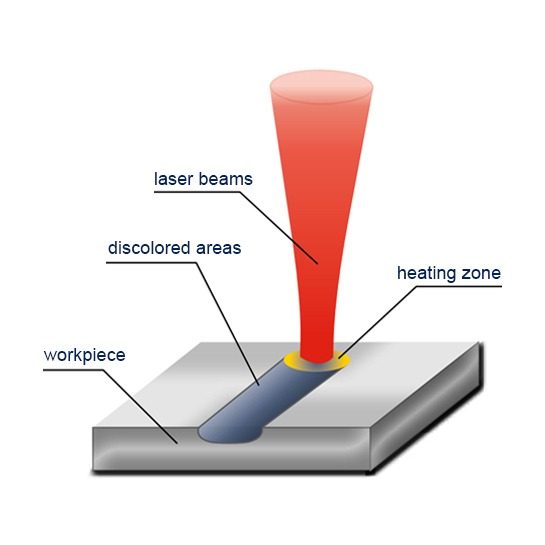
In the case of using laser carbonization, the color of the marked material always becomes darker.
The plastic breaks, and the carbon in the glue will be released. The resulting discoloration ranges from gray to blue-gray and black. Carbonization is used on light-colored plastics and organic materials (paper, packaging materials, wood, and leather) where the color varies from light to dark.
Links to related content
- List items #1
- List items #2
- List items #3
Discoloration
Marking material : Thermoplastic material
On some thermoplastic materials, “ultraviolet lasers” can be used for bleaching. This effect is also known as “cold marking” to reduce the “heat footprint” on the substrate.
There are great advantages in terms of contrast, speed and stability of the marking process, especially if laser-sensitive additives are used in plastics.
Additives in plastics improve contour definition and contrast, which in turn improves the readability of marked content, such as machine-readable codes. When used with transparent and translucent materials, additives result in uniform contrast dispersion. Additives in plastics increase the variety of product colors and are critical to the markability of certain materials.
Links to related content
- List items #1
- List items #2
- List items #3

Subsurface engraving
Marking material : glass, transparent material
Made by microcracks caused by local absorption by the laser.
Microscopic cracks can cause multiple internal light reflections, which can make the spots appear white. 2D and 3D images can be created inside the glass without affecting the polished surface. The image is created point by point, and the workpiece moves in 2D or 3D. This technology is popular for decoration and tamper-proof tracking.
Links to related content
- List items #1
- List items #2
- List items #3