
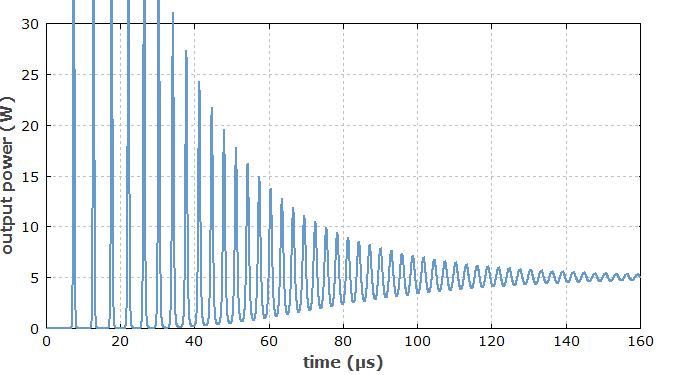
Relaxation oscillation refers to small oscillations in which the laser power and laser gain are coupled to each other around their steady-state values. When a laser is disturbed during operation, for example due to fluctuations in pump power, its output power does not immediately return to a steady state.
Many lasers, such as solid-state lasers and most laser diodes, operate in so-called Class B states, where the upper energy state lifetime is usually much longer than the damping time of the laser resonator. In this case, the laser dynamics are such that the change in pump power leads to so-called relaxation oscillations, which are often damped and eventually lead to a return to a steady state.
In doped insulated solid-state lasers, the oscillation behavior is particularly pronounced at relatively low frequencies (usually in the kilohertz range), while semiconductor lasers typically exhibit highly damped relaxation oscillations in the gigahertz region. Other lasers, such as many gas lasers, operate in Class A systems where the upper energy state lifetime is lower than the cavity damping time and does not exhibit relaxation oscillations.
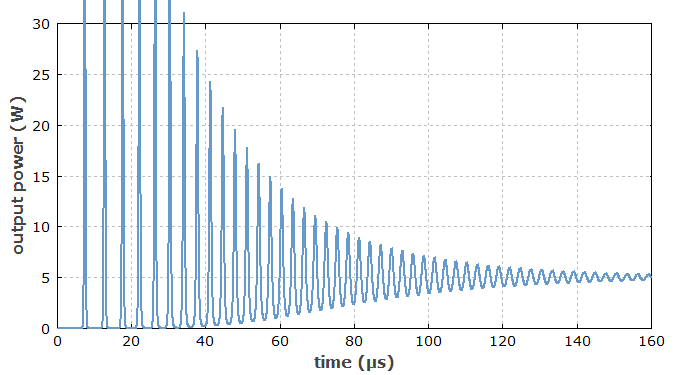
Simulate the turn-on dynamics of the Nd:YAG laser, assuming that the pump power is turned on suddenly. Before reaching a steady state, the laser emits many spikes and undergoes a damped relaxation oscillation.
Class B lasers can exhibit strong spikes, such as when the pump power is suddenly turned on. After emitting a few spikes (pulses), the laser power exhibits damped relaxation oscillations at a frequency similar to the counter-periods of the spikes.
Be the first to comment