
The stimulated emission process can achieve a geometric progression increase in the number of photons in the same state, and the light field density and light intensity are proportional to the number of photons or photon number density per unit volume, which is essentially a coherent amplification process of light.
The prerequisite for this condition to occur is that there are enough microscopic particles in the excited state, so how many particles are needed to be in the excited state to achieve coherent amplification of light? Normally, matter always absorbs light rather than amplifying it.
Amplification and absorption
Under the condition of thermal equilibrium, the microscopic particles absorb and emit an equal number of photons per unit of time.
- When the number of absorbed photons is greater than the number of emitted photons, the matter exhibits a state of net absorption of incoming light.
- When the number of emitted photons is greater than the number of absorbed photons, the matter appears to the incoming light in a state of light amplification.
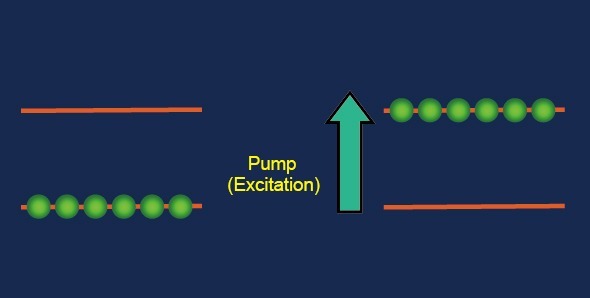
Obviously, we want the matter to appear magnified in response to the incident light, which is called the inversion of the number of particles. Physical definition: The density of the number of particles evenly distributed to each degenerate energy state at the high energy level is greater than the corresponding value of the low energy level, and the particle number amplification is a necessary condition for the realization of light amplification.
The number of particles is reversed
We call the technique of excitation of microscopic particles into the excited state as a pump, and there must be a suitable pumping method to achieve particle number reversal.
However, the particles are continuously excited to the excited state by pumping, but the lifetime of the excited state may be very short, and we can never let the particles gather in large numbers on the excited state and achieve the particle number reversal. The second condition for achieving particle number reversal is to choose a working substance with a metastable state, and it is much easier to achieve particle number reversal if the excited state is a metastable energy level.
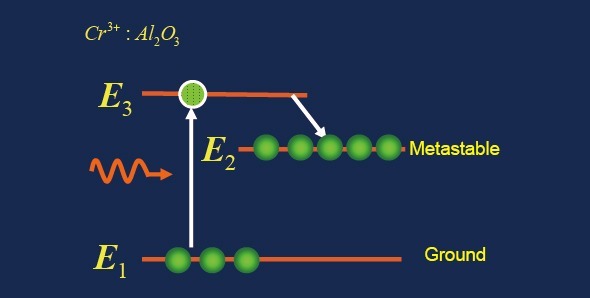
The working material of the ruby laser is Cr3+:AL2O3, and through the irradiation of the flash lamp, we can make the Cr ions gather on the metastable energy level E2, and realize the particle number reversal between the ground state E1 energy level.
Be the first to comment