
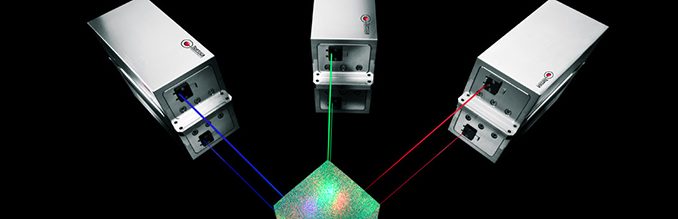
The term visible laser is used to denote the light emitted by a laser that emits visible light, and sometimes the laser device is converted by a nonlinear frequency that produces visible light. Visible light (for the human eye) corresponds to a wavelength of light between 400 nm and 700 nm.
A laser that can be directly seen emitted by light
Lasers that emit visible light directly are in the minority—most lasers emit in the infrared spectral region, examples of solid-state lasers that emit visible light are:
- Various laser diodes can emit visible light. For example: red laser diodes based on GaInP and AlGaInP, and blue light-emitting diodes based on GaN;
- The first to be demonstrated was a ruby laser that emits 694.3 nm;
- Titanium-sapphire lasers emit mainly in the infrared spectral region, but can be tuned down to about 650 nm;
- There are various upconversion lasers, including bulk lasers and fiber lasers, that are capable of visible light emission. a variety of gas lasers that emit visible light;
- The HeNe laser is the visible light emission that the first gas laser has, and it can emit a variety of visible light wavelengths, including the well-known red wavelength of 632.8 nm, but it can also emit green (543.5 nm), yellow (594.1 nm), and orange (604.6, 611.9 nm) spectral regions;
- Helium-cadmium lasers (→ metallic vapor lasers) emit blue light at 441.6 nm;
- Argon-ion lasers mainly emit 514.5 and 488 nm, but also 465.8, 472.7 and 528.7 nm;
- Krypton-ion lasers emit a variety of wavelengths across the entire visible spectrum, especially 647.1 nm and 530.9 nm;
- Copper steam lasers (→ metal steam lasers) emit at 510.6 nm (green) or 578.2 nm (yellow).

Visible lasers
Finally, various dye lasers have a wide emission range across the entire visible spectral region.
Nonlinear frequency conversion of visible lasers
Various methods allow visible light to be generated in a laser diode by nonlinear frequency conversion:
- The most commonly used methods, for green and blue emission frequency doubling, either in the cavity or in external nonlinear crystals (single-pass or resonant), these can be applied to conventional solid-state lasers and of course to VECSEL. The most common is the green emitting laser source of frequency-doubling 1064 nm neodymium lasers;
- The sum frequency of visible light generated in a nonlinear crystal, such as the sum frequency mixture of a 1064 nm Nd:YAG laser and a 1.5 μm fiber laser, will produce red light;
- A Raman laser is pumped with a conventional laser, which is usually done with a solid-state laser. It may be Q-switched or continuous-wave, and the intracavity frequency will be doubled.
For broadband visible radiation, there are laser sources that involve the generation of a supercontinuum.
Be the first to comment