
Bandwidth refers to the width of a range of frequencies or wavelengths. Formula symbols: Δ ν, Δ λ, unit: hertz, nanometer.
In photonics, the term bandwidth comes up in many different contexts.
Optical frequency range width
- A light source can have a certain optical bandwidth (or linewidth), which is the width of the output spectrum. For narrow linewidth lasers, the bandwidth can be very small—in extreme cases below 1Hz, which is many orders of magnitude less than the average optical frequency. On the other hand, ultrashort pulses with a pulse duration of a few femtoseconds can have very large bandwidths – easily reaching tens of terahertz.
- Optical bandwidth can be the width of a frequency range that an optical component or photonic device handles in some way. For example, it can be the reflection bandwidth of a mirror, the optical transmission bandwidth of an optical fiber, the gain bandwidth of an optical amplifier, or the phase-matching bandwidth of a nonlinear optical device.
The common definition of spectral width is full width at half maximum (FWHM), but there are other definitions. For example, some authors use half width (HWHM), which is only half the size of FWHM.
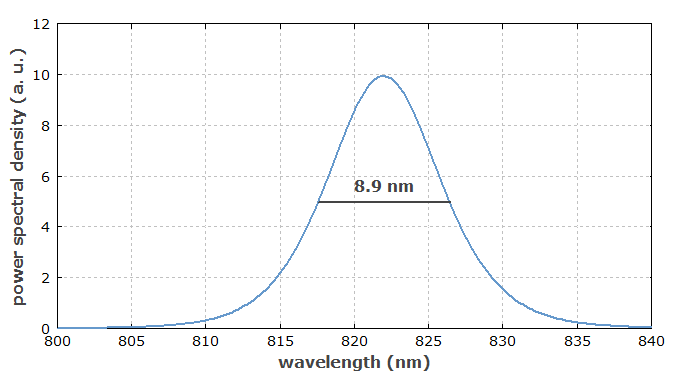
The optical spectrum of the 80-fs ultrashort optical pulse has a full width of 8.9 nm at half height, which is equivalent to 3.9 terahertz
The optical bandwidth value can be specified based on frequency or wavelength. Since frequency and wavelength are inversely proportional, the conversion coefficient between gigahertz and nanometer depends on the center wavelength or frequency. To convert the (small) wavelength interval to the frequency interval, the equation:Δν=c*Δλ/λ2
It can be obtained by considering the derivative of ν = c/λ with respect to λ, which shows that if the center wavelength is shorter, the frequency bandwidth corresponding to the 1nm wavelength bandwidth is higher. The optical bandwidth of the light source is closely related to the time coherence, and is characterized by the coherence time.
For the output of passive resonators (e.g., optical cavities) and oscillators (e.g., lasers), the Q factor is the oscillation frequency divided by the bandwidth.
Modulation bandwidth
The bandwidth can also indicate the maximum frequency at which a light source can be modulated, or the frequency at which the modulated light can be detected with a photodetector.
In the field of fiber optic communications, the term bandwidth is also often used inaccurately for the data rates achieved in optical communication systems (e.g., in Gbit/s). A more appropriate term is data rate or data transmission capacity, to avoid confusion with optical bandwidth.
The bandwidth of the photodetector
Photodetectors have a finite bandwidth, which in this case refers to the frequency range in which optical power modulation can be detected. Typically, this frequency range will start at zero frequency, but this is not the case in some cases (AC-coupled photodetectors). In the common case of DC-coupled photodetectors, the bandwidth is equated to the maximum detectable modulation frequency according to some standards. Typically, people specify a 3 decibel bandwidth, meaning that the signal power (proportional to the square of the output voltage or current) decreases by 3 dB of frequency. This amount is related to the rise and fall times. If these times are equal, it can be estimated to be 0.35 divided by 3 dB bandwidth.
Be the first to comment