
Coherence is one of the most important concepts in optics and is closely related to the ability of light to exhibit interference effects. When there is a fixed phase relationship between the electric field values at different locations or at different times, it is called a coherent light field.
The coherence conditions of the waves are that the frequency is the same, the direction of vibration is the same, and the phase difference is constant. When two waves interfere with each other, constructive interference or destructive interference will occur due to the difference in phase. If the phase difference between two sine waves is constant, the frequencies of the two waves must be the same, and the two waves are said to be "perfectly coherent". Two "completely incoherent" waves, such as those emitted by an incandescent lamp or the sun, cannot be clearly observed due to the unstable interference pattern generated. Between these two extremes, there are "partially coherent" waves.
It's also common to refer to certain processes or techniques as coherent or incoherent, in which case "coherent" essentially refers to phase sensitivity. For example, the method of coherent beam synthesis generally relies on the intercoherence of the beams, while spectral (incoherent) beam synthesis does not depend on the intercoherence of the beams.
The coherence of space and time
There are two distinct aspects of coherence:
- Spatial coherence refers to the strong correlation between electric fields at different locations in the beam profile (fixed phase relationship).For example, within the beam cross-section of a laser whose beam quality is limited by diffraction, the electric field at different locations oscillates in a perfectly correlated manner, even if the temporal structure is complicated by the superposition of different frequency components. Spatial coherence is a necessary prerequisite for the strong directionality of the laser beam.
- Temporal coherence means that there is a strong correlation between electric fields at one location but at different times.For example, the output of a single-frequency laser can exhibit very high temporal coherence, because the evolution of the electric field in time is highly predictable: it exhibits a clean sinusoidal oscillation over a long period of time.
Figures 1~3 further illustrate the difference between spatial and temporal coherence. For reference, Figure 2 shows a monochromatic Gaussian beam exhibiting perfect spatial and temporal coherence.
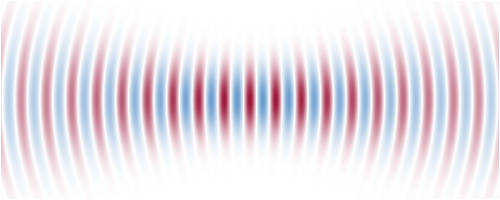
Figure 2 shows a beam with high spatial coherence but poor temporal coherence. The wavefront formation is as above, and the beam quality is still high, but the amplitude and phase of the beam vary along the direction of propagation. Note that the local amplitude and spacing of the wave face vary to some extent. Such a beam can be generated from the output of a supercontinuum spectrum, for example:
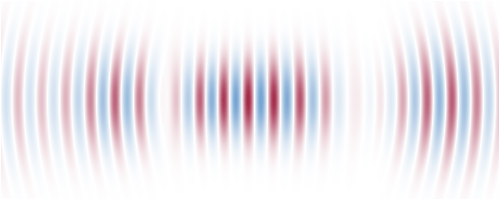
Figure 3 shows a laser beam with reduced spatial coherence but high temporal coherence. The wavefront is deformed, resulting in high beam divergence and poor beam quality. On the other hand, the beam is monochromatic, so the spacing of the deformation wavefront remains the same. Such a beam can be generated by a single-frequency laser output when passing through some optically inhomogeneous material.
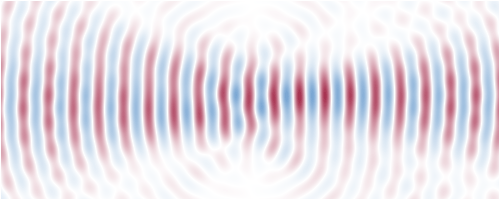
If a laser beam with a high degree of spatial coherence is fed through an optical diffuser element (e.g., a very inhomogeneous piece of glass), the element completely disturbs the wavefront. As long as the wavefront distortion does not change with time, the resulting distorted beam can still be considered spatially coherent in principle. Because the phase relationship between the electric fields at different points is still fixed. In principle, it is also possible to restore a simple beam shape by applying another optical element that compensates for complex spatial distortion. However, for most practical purposes, this distorted beam is spatially irrelevant. However, a true disruption of spatial coherence requires time-varying wavefront distortion, which can be obtained, for example, by rotating a diffuser. In this case, the temporal coherence is also somewhat reduced, whereas if only a fixed diffuser is used, the temporal coherence is completely maintained.
Coherence of lasers
Spatial coherence
Lasers have the potential to produce beams with very high spatial coherence (e.g., Gaussian beams), which is probably the most fundamental difference between laser radiation and other light sources. The high spatial coherence of the laser stems from the presence of a resonator mode, which defines the spatially dependent field mode.
Temporal coherence
When there is only a single resonator mode with sufficient laser gain to oscillate, a single longitudinal mode can be selected, resulting in a single frequency operation with very high temporal coherence. Using additional techniques to stabilize the frequency can further reduce the line width to a great extent. Some laser systems serve as optical frequency standards with linewidths below 1 Hz, which means extremely high temporal coherence and coherence lengths of hundreds of thousands of kilometers.
On the other hand, many lasers emit in multiple modes with very different optical frequencies and correspondingly low temporal coherence. Even for single-frequency lasers, the consistency in time will be weak due to strong phase noise. This is often seen in laser diodes, for example.
A special case is lasers for ultrashort pulses, where the relationship between optical bandwidth and time coherence is important. Pulse trains from mode-locked lasers can have a wide total bandwidth, and the Fourier spectrum consists of discrete very narrow spectral lines (frequency combs). Time coherence can be very high because there is a strong field correlation for large time delays close to integer multiples of the pulse period.
Be the first to comment