
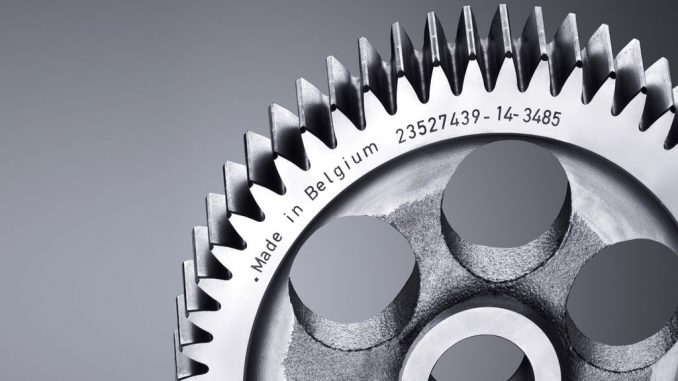
During laser engraving, the laser beam ablates the material, creating a groove with various surface structures – the so-called laser engraving pattern. Many materials can be laser engraved. For example, laser engraving of metal results in a rough structure that appears black and a smooth structure that appears white.
Laser engraving is often used in the automotive industry or in the field of electric motors. In rapid prototyping and rapid machining, laser engraving is often used for marking and depth engraving.
The production process of laser engraving
In the laser engraving process, a combination of melting and evaporative ablation is used to form the mark. The radiation intensity of the laser beam is so high that the material melts and partially evaporates during processing. A groove is formed in the material, i.e. a laser engraved pattern. Typically, the engraving depth is 10 to 50 μm. Due to the vapor pressure of the evaporated material, the metal melt is expelled at the edge and solidifies as the edge when cooled. The engraved pattern is U-shaped in shape and becomes narrower as the laser enters deeper and deeper into the material, as the metal melt can no longer be completely discharged. Heat entry is severely limited by small laser spots at the site and by very short pulses in time.
Commonly used laser engraving process
Deeply engraved patterns
For tool and die making or vehicle identification numbers, laser-engraved patterns must be produced at a greater depth in the millimeter range. Often, multiple layers must be processed in shifts to achieve the desired depth.
Black engraved pattern
When laser engraving metal, a contrasting oxide is formed due to the interaction of the molten substrate with oxygen in the air. Most very rough surfaces absorb a lot of light, so the markings are usually shown as black, or dark gray (aluminum) or dark brown (steel, brass, copper) depending on the material.
White engraved pattern
For white engraving patterns, the surface should be structured in such a way that the material melts only slightly. The result is a smooth, highly reflective surface – which is marked in white for materials such as galvanized steel. Due to the low immersion depth, the coating remains intact and corrosion-resistant. Especially for dark-colored metals such as hardened steel, the high-contrast white engraving pattern has proven its advantages. The combination of black and white engraving patterns is especially suitable for the application of QR codes. This increases the contrast and improves the quality and readability of the QR code.
Reasons to choose laser engraving
Non-contact, precision tool lasers offer many advantages in ablating and engraving materials. Thanks to the flexible choice of pulse frequency and pulse duration, each laser engraving pattern can be individually adapted to any material and any desired quality.
- Fast: Laser engraving has a high repetition rate and therefore short cycle times, so laser engraving is a faster process than tempering marking, despite the greater depth of immersion into the material.
- Abrasion-resistant: Thanks to the grooves that form in the material during the laser engraving process, the marks are particularly robust and resistant to external influences.
- Gentle: Temperature-sensitive sensors or electronic chips can also be marked, thanks to the local restriction of heat ingress.
- Repeatable: Thanks to the targeted control of the laser power, the marking results are always reproducible precisely.
Be the first to comment