
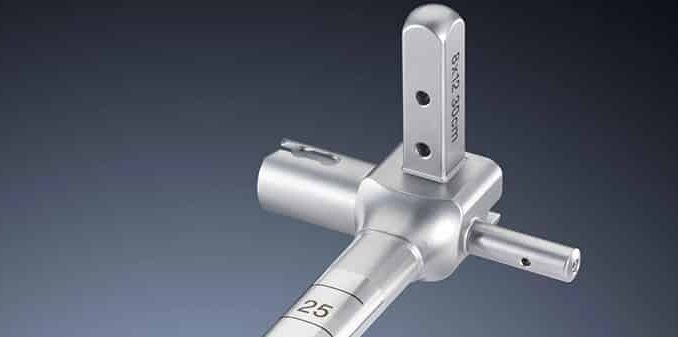
Tempering is a proven method for long-lasting marking steel and metal. Because these materials show a temper color when heated with a laser. This largely depends on the temperature to which the metal is heated. Because an oxide layer is formed on the surface during tempering, its properties determine the color effect.
The main advantages of tempered marking: the surface remains intact, the marking is legible, durable and resistant to wear and tear. Tempering is ideal for all scenarios where a fit must be met or material chips must not be formed. As a result, this process is ideal for consumer goods such as cookware or medical products.
How tempering works
To create a tempered mark, the laser heats the metal locally to just below its melting point. At this point, the structure of the gate changes; An oxide layer is formed on the surface of the workpiece, which manifests itself in various tempering colors. These colors remain temperature-stable up to about 200 °C. At higher temperatures, the gate returns to its initial state - the marker disappears. The surface properties will be intact.
In principle, only metals that have changed color under the influence of heat and oxygen (i.e. steel and titanium) can be traced, and aluminum or non-ferrous metals cannot be tempered. Tungsten carbide cannot be marked with dark contrast using tempering marking.
What are the advantages of laser tempering?
- Protection of the material: The surface of the material is virtually unaffected by the marking process and remains smooth even after marking.
- Simple cleaning: Due to the smooth surface, organic residues have little to no attachment to the tempering mark. As a result, they are particularly suitable for objects that are frequently cleaned.
- Long-lasting and easy to read: Even after several cleaning cycles, as is often the case in many medical technology products, the temper mark remains intact and legible.
- Proven and suitable for product marking: Tempered marking, which has matured in recent years in the field of medical technology, is ideally suited for product marking in addition to the new black marking with ultrashort pulse lasers, and thus enables unique traceability according to the UDI directive.
Be the first to comment