
Laser (laser radiation) is light produced by a laser device.This light has very special properties that make it very different from other sources of light:
- The laser is usually delivered in the form of a laser beam, which means that it propagates mainly in a well-defined direction with moderate beam divergence. This laser beam has a large degree of spatial coherence. This means that there are different positions on the beam profile where the electric field oscillates in a rigid phase relationship. It is this coherence that is the reason why the laser beam can not only travel long distances but also does not have too many factors in lateral diffusion, and for what reason it can be focused to very small light spots (high focusability of the laser beam).
- In many cases, lasers also possess a high degree of temporal coherence, which is equivalent to a long coherence length. This means that the phase stiffness relationship is maintained over a relatively long time interval, corresponding to a large propagation distance (typically several kilometers) or a large number of oscillation periods.
- Time uniformity is quantified in terms of coherence time or coherence length, which is associated with a narrow spectral bandwidth (or linewidth). (The complication of ultrashort bursts, which can have a large optical bandwidth but still have a high correlation, is ruled out here.) For a visible laser beam, this means that it has a solid color, such as red, green, or blue, but not white or magenta. Some lasers allow for some degree of wavelength tuning (e.g. dye lasers). This coherence length introduces a tendency for laser speckle, which is a characteristic pattern of particles that can be observed when the laser beam hits a metal surface.
- In most cases, lasers are linearly polarized. This means that the electric field oscillates in a specific spatial direction (→ polarization of light).
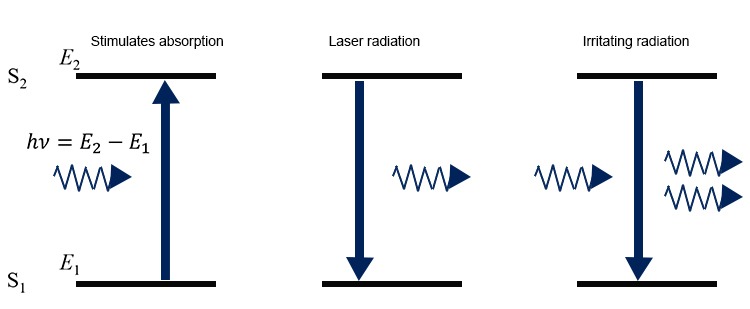
Depending on the actual situation, there are other obvious characteristics of the laser:
- Lasers may be visible, but most lasers are actually emitted in other spectral regions, especially in the near-infrared region, which is not perceptible to the human eye.
- The laser will also not be continuous, but can be delivered in the form of short or ultrashort pulses. As a result, if the pulse duration is much lower than the time distance of the pulse, the peak power will be very high—for some amplified laser systems well above 1TW (1012W), this may result in large pulse energies.
- The noise characteristics of lasers are also interesting (→ laser noise), for example, the oscillation frequency of the laser can be stabilized within a very narrow range.
In contrast, the light emitted by incandescent lamps is mostly visible, but mostly infrared, has a high spectral bandwidth, is not strongly focused (due to low spatial coherence), and cannot be produced in short pulses.
In addition to fire and certain hazards, lasers can be extremely harmful, especially to human eyes and skin. Laser pulses are often particularly dangerous because they can have extremely high light intensities and invisible laser beams that increase specific risks.
Be the first to comment