
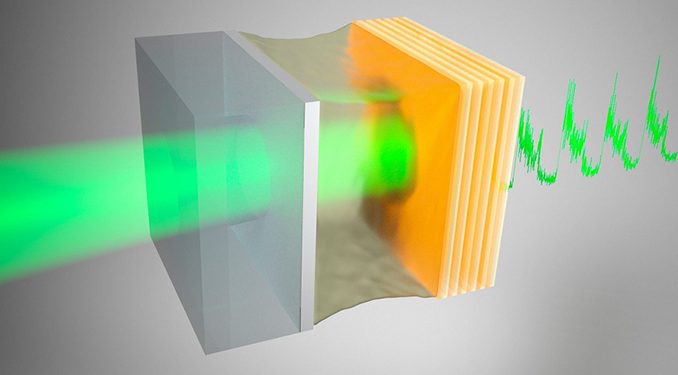
A resonator is an optical cavity (the resonator whose role is a resonant enhancement) optical power or intensity: if the incident light is resonant with the cavity and pattern matched to it, the power in the cavity can be much higher than the incident power, especially for high-precision cavities, which are often used for a number of purposes—usually for efficient nonlinear frequency conversion. The topography of the cavity can be either linear cavity or toroidal resonator.
Enhanced resonators can contain other optical components, such as nonlinear crystals that can be used for efficient nonlinear frequency conversion, such as frequency doubling [1] or sum frequency generation. The diagram shows a monolithic frequency multiplier consisting of a dielectric-coated nonlinear crystal on the end face of the pump wave (red) resonance, and the frequency doubling light is extracted on the right side. Even nonlinear processes are converted into a small fraction of the cyclic optical power, and the resonator does some form of recycling of unused light. If impedance matching can be achieved, the conversion is very efficient, assuming that the input mirror transmission is equal to all remaining resonator losses.

By using a dual resonance scheme, both the pump wave and the second harmonic are resonant, and the frequency doubling will show a lower power (a few milliwatts) to achieve efficient conversion, but the double resonance is generally difficult to maintain.
The resonant frequency doubling should not be confused with the intracavity frequency doubling, because the nonlinear crystal is placed in the laser cavity, so a separate resonator is not required.
Effective resonance enhancement condition
In order to enhance the effective operation of the cavity quilt, the following factors must be taken into account:
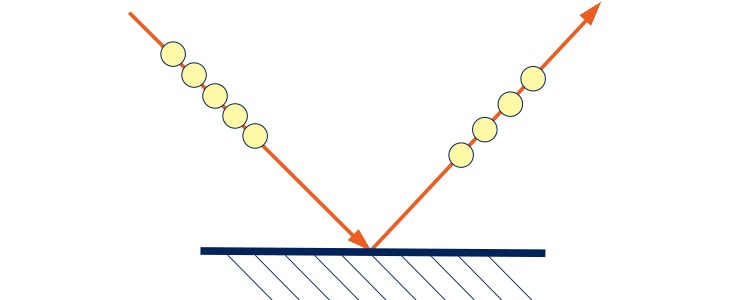
- The resonance conditions can generally only meet the requirements of single frequency light or frequency comb. The condition that leads to resonance requires that the resonator length must be correct within a small fraction of the optical wavelength. Electronic feedback loops are usually resonant for long periods of time. This feedback loop can adjust the optical frequency of the laser to match the cavity frequency, or the cavity length can be adjusted by a piezoelectric brake under the resonator mirror. Note that for high-precision cavities that greatly increase power, the stability of the cavity and the laser is very high.
- The incident radiation must be spatially matched to the cavity pattern, e.g. with suitable optics for focusing and alignment. In the case of incident light, it is necessary to ensure the quality transmission of the diffraction-limited beam.
- Losses are minimized by the back reflection of the pump power, and the reinforcement cavity should be impedance matched. This means that the transmission coefficient of the input mirror of the pump radiation is matched to the coefficient that quantifies the other losses.
Electronic feedback loops
Reinforcement cavity for mode-locked lasers
Reinforcement cavities are typically used with single-frequency lasers, but can also be used with mode-locked lasers. In the latter case, we have to choose the cavity length, which makes the reinforcement cavity round-trip time an integer multiple of the pulse interval. In summary, the free spectral range of the cavity must be several times the pulse repetition rate of the laser, so that all lines (→ frequency combs) of the laser output can be resonated at the same time. In addition, intraluminal dispersion and nonlinearity should not be too strong [8].
More recently, the reinforcement cavity has been used with very strong ultrashort pulses in order to obtain high harmonics at ultra-high pulse repetition rates [6, 7]. The challenges come from the need for precise in-cavity dispersion compensation, the very high light intensity on resonator mirrors and other optics, and the beam distortion caused by plasma generation in the gas used for higher harmonic generation.
Be the first to comment