
For macroscopic objects, such as cars, airplanes, ships, and trains, we can describe their state in terms of physical quantities such as position, velocity, acceleration, orbit, kinetic energy, and energy. Their laws of motion can be described by Newtonian mechanics theorems, which allow us to exert forces on macroscopic objects to continuously change their position, velocity, momentum, and energy.
However, in the microscopic field, when we describe the motion of microscopic particles such as electrons, we find that their current position, velocity, acceleration, and motion orbit cannot be accurately obtained, and Newton's laws no longer apply. It is necessary to use quantum theory and wave-particle duality to explain the motion of microscopic particles, and the corresponding physical quantities are: stationary state, energy level, and transition. According to quantum theory, the theory of motion of microscopic objects is significantly different from that of macroscopic objects.
Microscopic particles
Microscopic particles are usually in an intrinsically motional state that specifically determines the energy, which we call a steady state, and the energy height of microscopic particles is called the energy level. Since the energy of the microscopic particle in the steady state can usually only be taken as discrete values, these energy levels are also independent of each other. We call the state with the lowest energy the ground state, and the other energy states as the excited state. Microscopic particles can only move from one state to another in a leaping way, a process we call transitions.

Energy level degeneracy
The motion of microscopic particles often occurs, different states of motion have the same energy, we call this state the energy level degeneracy, and the number of particles in the same energy state of motion is called the energy level degeneracy.
For example, if there are g states of motion corresponding to the same energy E, then the degeneracy of energy level E is g. As shown in the figure below, the energy level degeneracies of E1, E2, and E3 are 4, 4, and 3, respectively.
Boltzmann distribution
For a system composed of a large number of microscopic particles, apart from the discrete energy of the particles and the jumpy jumps, another significant difference between the motion of the microscopic particles and the motion of macroscopic objects is that we cannot track the motion of every particle. It is not possible to obtain the energy state corresponding to the particles at a given time, only the probability that they are in a certain energy state, or the proportion of a certain energy level occupied by the particles.
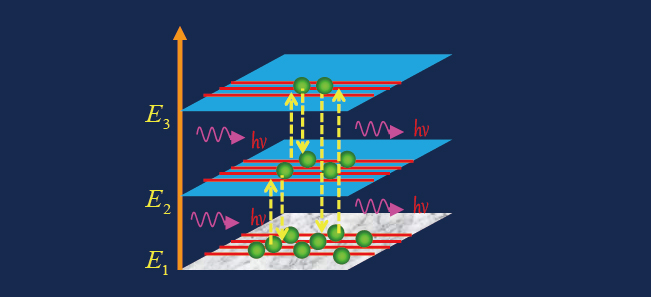
Statistical physics shows that under thermodynamic equilibrium, the distribution of particles in different energy states is Boltzmann distribution. The Boltzmann distribution is a dynamic distribution, in which particles constantly transition between different energy levels, constantly absorbing and emitting photons, and the emitted light is known as thermal radiation. For example, the sun and flames are common sources of high-temperature heat radiation, and our human body and other objects at room temperature are low-temperature heat radiation sources, and the electromagnetic waves they radiate are mainly concentrated in the infrared band.
Be the first to comment