
The laser is one of the important inventions of mankind in the 20th century, and its invention has gone through a considerable process.
In 1900,M. Planck proposed the energy quantum hypothesis, which accurately explained the law of blackbody radiation, the concept of energy particles: matter absorbs and emits electromagnetic energy one by one.
In 1905,Albert Einstein proposed the quantum hypothesis of light to explain the law of the photoelectric effect. In order to explain the experimental law of the photoelectric effect, Einstein further proposed the concept of light quantum. That is, the energy of the light field or electromagnetic field itself is one by one, and the energy of this piece is called a photon. According to Einstein's hypothesis, photons have energy, momentum, and mass, just like microscopic particles such as principles and particles. Einstein's photon theory unified the two contradictory properties of waves and particles, which are now called "wave-particle binomialities".

In 1913,Danish physicist Bohr built a model of the structure of hydrogen atoms and successfully explained and predicted the spectrum of hydrogen atoms. In Bohr's model of the structure of the hydrogen atom, important concepts such as the stationary state or energy level of atomic motion, as well as transitions, are proposed. Hydrogen atoms have a stable series of energy states that can transition from one energy state to another, accompanied by photon absorption and emission at a specific frequency.
The frequency conditions for absorbing and emitting light are met:hv=E2-E1,E2-E1 is the difference between the two energy levels,hv is the energy of one photon.
In 1916,Einstein used the concept of photons to re-derive Planck's formula for blackbody radiation. It is pointed out that there should be three processes in the resonant interaction between light and matter: spontaneous radiation, stimulated radiation, and stimulated absorption.
- Spontaneous Radiation:The physical process in which a particle spontaneously transitions from a high-energy state to a low-energy state and emits a photon at the same time.
- Stimulated absorption: The physical process by which a particle absorbs a photon to transition from a low-energy state to a high-energy state.
- Stimulated radiation: A physical process in which a particle transitions from a high-energy state to a low-energy state under the perturbation of an incident photon from an extraneous photon, and at the same time produces a photon identical to the perturbated photon.
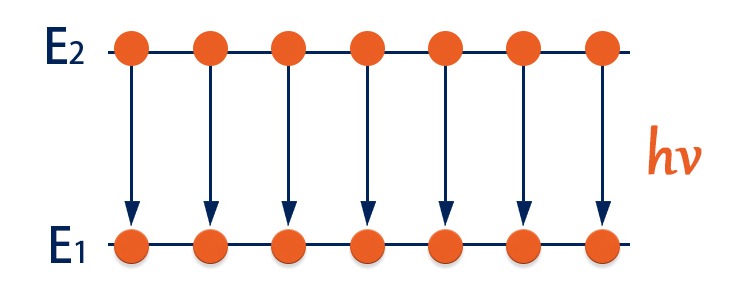
If enough microscopic particles are in a high-energy state, the stimulated transition will have a knock-on effect. 1 photon produces 2 photons, 2 becomes 4, stimulated emission photons will show a geometric progression, and eventually produce a large number of photons with the same state, such a light source is a strongly coherent light source. Despite this, in the 30 years since Einstein introduced the concept of stimulated radiation, people did not realize the practical usefulness of the concept.
In 1946, Bloch proposed the concept of particle number reversal.
In 1947, Lamb and Retheford pointed out that stimulated radiation could be achieved by inverting the number of particles, and it was only then that people rediscovered the importance of the concept of stimulated radiation proposed by Albert Einstein in that year.
In 1948, Bussell experimentally discovered for the first time the phenomenon of particle number rotation, and there were more particles at higher energy than particles at lower energy. For this discovery, Botsell and Bloch were jointly awarded the 1952 Nobel Prize in Physics.
In 1949, Kastler was awarded the Nobel Prize in Physics in 1966 for his invention of the light pump, which allowed the microscopic particles in matter to achieve a state of particle number reversal.
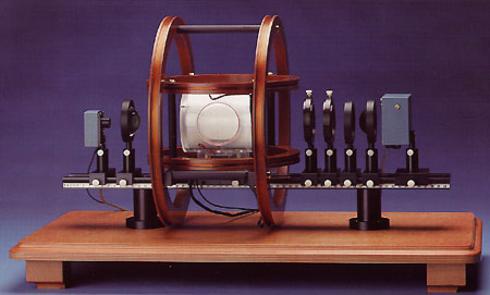
In 19521, Weber first proposed the principle of achieving stimulated radiation in the microwave band.
In 1954, Towns, Prokhorov, and Basov invented the ammonia molecule Maser (Microwave Laser Amplifier).
In 1958, Xiao Luo and Townes published a paper entitled "Infrared Region and Optical Casser" in the journal Physical Review, demonstrating the possibility of extending microwave lasing technology to the infrared and visible regions, which became an important historical document in the history of laser development.
In 1960, Mehmann invented the first laser, the ruby laser.

In 1961, under the auspices of Wang Zhijiang, the first ruby laser in China was successfully developed.
In the years that followed, lasers with gases, ions, glass semiconductors, etc. as working materials were manufactured one after another, resulting in many practical applications.
Be the first to comment