

Due to the various laser noises that can be detrimental in this application, techniques to suppress noise and stabilize certain laser parameters are required. Of course, there are both active and passive stabilization options, as discussed below:
Active Laser Stabilization System
Active stabilization schemes typically involve some sort of electronic feedback (or sometimes feed-forward) system, in which some parameter fluctuations are converted into electronic signals that are then used in some form for the laser, such as:
- The output power of the laser is stabilized as shown in Figure 1. The laser power is monitored by a photodiode and corrected by controlling the pump power or losses inside and outside the laser resonator. In this way, the spike signal after start-up and the intensity noise under steady-state conditions can be reduced.
Note: Intensity noise is reduced by outputting a beam rather than the laser itself.
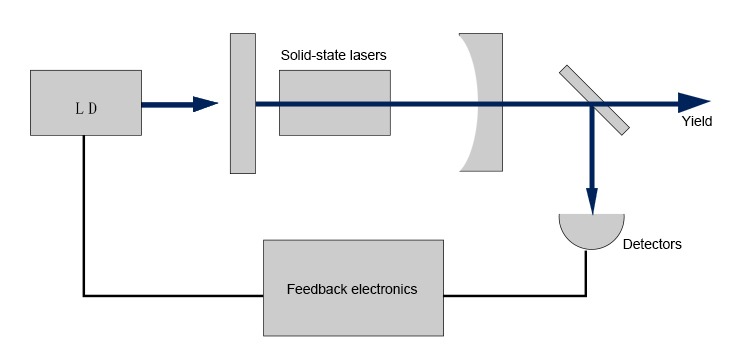
- On the optical frequency of a single-frequency laser, there is a line of frequency comb from the mode-locked laser, which can be stabilized by the resonator length. The feedback signal can be obtained by recording with a second laser, by measuring the power transmitted or reflected on a very stable reference cavity or another interferometer, or by measuring the transmission of an air chamber (e.g. an iodine cell), using a Doppler-free laser absorption spectrum. A common technique for generating error signals using a reference cavity is the method of the laser lock principle [3, 4], which uses light-weak phase modulation sent to the reference cavity. The one that did not require this modulation scheme was Hänsch-Couillaud [2]; Another method is tilt locking, which makes use of spatial mode interference [15, 29].
- The stability of the carrier envelope offset phase or frequency (CEO stability) of mode-locked lasers, such as phase measurements with f− 2 f interferometers and feedback via certain wedges or tilt mirrors in the laser resonator, is important for frequency metrology.
- The pulse timing (→ timing jitter) of a mode-locked laser can be monitored by comparing the photodiode signal with the phase of the electron reference oscillator, and the laser is stabilized by the control of the cavity length.
- Correction is made by means of beam position measurements (e.g. using a four-quadrant photodiode) and piezoelectically controlled resonator mirrors, which stabilize the direction in which the output beam is pointed.
The stability achieved with such an active system depends on factors such as the photoelectric detection noise, the bandwidth of the control element, the design of the feedback electronics, and the stability of a reference standard (e.g., an optical reference cavity).
Passive laser stabilization system
Passive solutions do not involve electronic devices, which are entirely optical effects, such as:
- The frequency of the laser is stabilized by optical feedback from a stabilized reference cavity. (This is also thought to be the use of an extended laser resonator, which is a composite cavity.) )
- Synchronous two mode-locked lasers are capable of cross-phase modulation in the Kerr medium, where the intracavity pulses of the two lasers are satisfied.
It is also possible to stabilize the laser frequency by injecting a lock, i.e., injecting a beam with a highly stable light frequency from another laser.
Be the first to comment