
I believe that everyone is familiar with the term laser, the laser pointer that the teacher may use in class, the laser printer used in printing, the photocopier used in the copy shop, the laser used in the hospital for beauty freckle removal and vision correction, and the Micius quantum satellite for signal transmission between heaven and earth. So what exactly is a laser, and how is it different from ordinary light?
The origin of the term laser
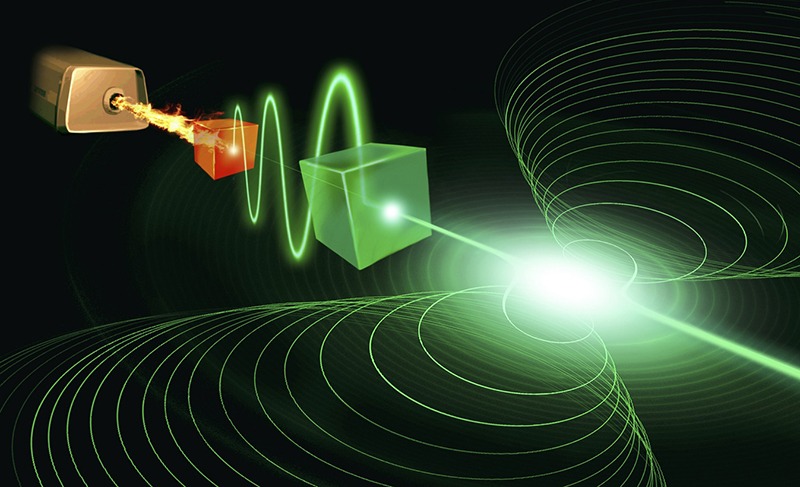
The English name of laser is composed of the first letter of each word of Light Amplification by Stimulated Emission of Radiatio, if we translate this phrase directly to meaning: stimulated emission amplification of radiation. This phrase precisely expresses the basis for the production of light, a special property of the laser, that is, stimulated radiation.
When the laser was first invented, Laser, as a new thing and a new noun, was originally translated as "Lace" and "Laser" according to pronunciation. At present, the term "laser" is still used in Taiwan and Hong Kong. In 1964, Qian Xuesen, a famous scientist in China, suggested that Laser be translated as "laser" to highlight the stimulated characteristics of this new light source, and the term laser has been used since then.
Nowadays, Laser refers more often to the equipment or device that produces lasers, which is what we often call lasers. Lasers or lasers are another major invention made by human beings in the 20th century, following atomic energy, computers and semiconductors, and is one of the four major scientific and technological inventions of the 20th century.
Characteristics of lasers
The laser source has significantly different characteristics from our ordinary sunlight, candles, incandescent lamps, energy-saving lamps, LEDs and other ordinary light sources. We can use three highs and one good to summarize the characteristics of laser and ordinary light sources.
1. Good directionality
The light emitted by any light source, with the propagation of light, the irradiated area of light will gradually increase, and the intensity of light will gradually weaken, this phenomenon is called the phenomenon of light divergence.
For example, the sun emits light like a 4PI solid angle, and the farther away from the sun the light intensity is, the light on Mercury will be strong, and the light on Pluto will be weak. The incandescent lamps, energy-saving lamps, and LEDs used in our daily lighting all have very obvious divergence phenomena. The divergent nature of the light source makes it impossible to guarantee that the light will reach a very long distance without a noticeable loss of intensity.
However, the properties of the laser light source change this situation, the laser has very good directionality, and its beam divergence angle can easily reach a few thousandths of an arc. By expanding the beam or collimating the beam, we can further control the divergence angle of the laser, and we can shine this almost parallel light from the ground to the satellite or vice versa, without the intensity of the beam dropping significantly due to divergence.
2. Good monochromaticity
As the name suggests, monochromacy refers to the singleness of the color of the light source, and more precisely, monochromacy should refer to: the singleness of the wavelength or frequency component of the light. Newton discovered through a prism that sunglasses contained many different colors of light, and he had poor monochromacy of sunlight from the perspective of monochromacy. In general, we can measure the monochromaticity of a light source by a ratio of the spectral width of the light source to the center frequency or wavelength.
For example, the monochromaticity value of the light source of the pure color LED lamp is only a few percent, while the monochromacy of the laser light source can reach the negative of 10 to the 11th power of the magnitude, and the monochromacy of the laser light source is obviously beyond the reach of the ordinary light source.
3. Good coherence
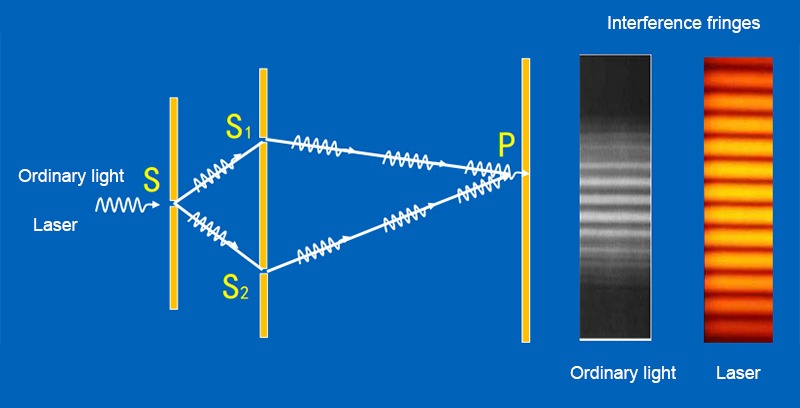
The phenomena of interference and diffraction are two important properties of light as a wave. Through the important Young's double-slit interference experiment, we can observe the interference fringes produced by light interference. If the above experiments are done with ordinary light sources, it is difficult to obtain clear and high-contrast interference fringes. And if we do the same experiment with a laser, the contrast of the interference fringes is very clear. The fundamental reason for this phenomenon is that lasers have very good coherence, while ordinary light sources generally have very poor coherence.
4. High brightness
Brightness refers to the amount of optical power that occurs in a certain direction within a solid angle of a unit. He characterized the concentration of the emission power of the light source in the direction, and due to the good directivity of the laser, its brightness can be very high, up to 10 billion times that of the sun. It is precisely because of the high brightness characteristics of the laser that the laser is highly dangerous to the human body and the human eye. Generally, at the exit of the laser or the laser laboratory and the place where the laser works, people will put corresponding labels and tell people not to look directly with the naked eye, and we need to wear laser protective glasses.
Be the first to comment