

The composition of the laser is composed of three parts: the working substance, the optical resonator and the pump source. The main function of the optical resonator is to provide positive feedback for the amplification of light, and this feedback has a good mode selection effect, so that the laser always works in a limited number of modes. What kind of optical structure can be called an optical resonator? Do they have to be two parallel planar mirrors?
The space in which light travels
The propagation space of light or electromagnetic waves can be divided into two types:
- Free space, borderless, optically homogeneous, such as vacuum, homogeneous medium, eigenmode is a monochromatic plane wave.
- Confined space, where light propagation is limited by reflection or refraction in one, two, or three dimensions.
The confined space that can form a closed optical path is called an optical resonator.
For example, light is limited by the reflection of the surface of glass microspheres, which can form a closed optical path, and light is reflected back and forth between two mirrors parallel to each other, which can form a closed optical path.

Light propagates in a flat waveguide or optical fiber, and although it is limited in the transverse direction, it cannot form a closed optical path and cannot constitute an optical resonator.
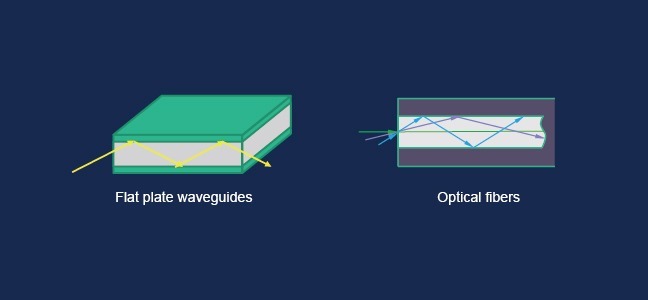
The optical resonator provides feedback to the optical path, resulting in interference growth or interference depletion. Interference cancellation forms a negative feedback, the light field tends to zero, and the light field cannot exist stably. The interference phase growth causes the feedback of light to form a resonance, forming a stable light field distribution that is not zero, and this light field is the mode of the resonator, which is also the reason why the confined space is called the optical resonator. The optical mode of the resonator has a definite spatial distribution form and eigenfrequency, which is determined by the structure and parameters of the resonator, and in the field of laser, the mode of the resonator is also called the laser mode.
Open optical resonator
If the flat waveguide and optical fiber add a certain limit to the propagation of light in the longitudinal direction, it can also form an optical resonator, and the reflection of the end face of the waveguide can be used to form a longitudinal feedback, and the Bragg grating can also be engraved on the waveguide or optical fiber, or the outgoing light can be recoupled back by using a reflector.

The closed cavity opens the two dimensions of light propagation, retains only one dimension, restricts the propagation of light, and uses optical mirrors to achieve feedback to light, such a resonator is called an open optical resonator. In the history of laser development, the proposal of open resonator has played a very important role in promoting the invention of lasers.Among the three major components of a laser, the optical resonator is the most critical factor that determines the output characteristics of the laser.

Be the first to comment