
The conditions under which a laser produces a laser oscillation
- The single-pass gain factor of small signal is greater than the average single-pass loss factor.
- The laser oscillation conditions show that the loss characteristics of the resonator have an important impact on the generation and output of the laser.
- Controlling the loss characteristics of the resonator is the main means of changing the laser oscillation and output characteristics.
The magnitude of the average loss of light propagating in a single pass (one round trip) within the propagation of light in the resonator is called the average one-pass loss factor.
In the optical resonator, there is always light to form a closed loop, and when the light propagates in the cavity, there will be different types of physical mechanisms to cause loss, and the resonator is lossy and has no gain, and such a resonant cavity is called a passive cavity.。Here are the 5 types of losses in resonators:
Transmission loss of the laparoscope
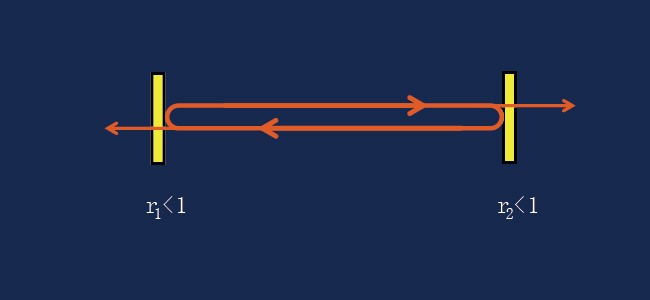
When light propagates in the resonator, there will be different physical mechanisms, resulting in light loss, which comes from the incomplete reflection of the cavity mirror, and the reflectivity of the cavity mirror of the resonator is generally impossible to achieve 100%. At least one of the endoscopes we actively let it have some transmission so that the oscillating laser light can be output. The incomplete reflection of the endoscope is a loss for the photons propagating in the cavity, and the greater the emissivity of the endoscope, the smaller the transmission loss of the endoscope.
Geometric deflection loss
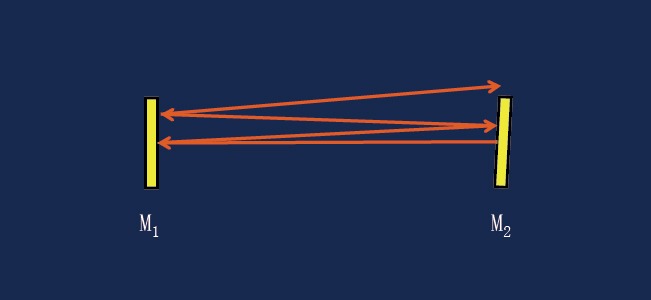
When the light rays propagate in the resonator, it is possible to deflect out of the side of the cavity, for example, in a resonator composed of two parallel mirrors, only the light rays that are strictly perpendicular to the mirror surface will not spill the light, and any light rays that are purely deviated in the perpendicular direction of the mirror will eventually deflect out of the cavity. If there is any deviation in the parallelism of the two mirrors, even light perpendicular to the lens will spill out of the cavity.
Diffraction loss
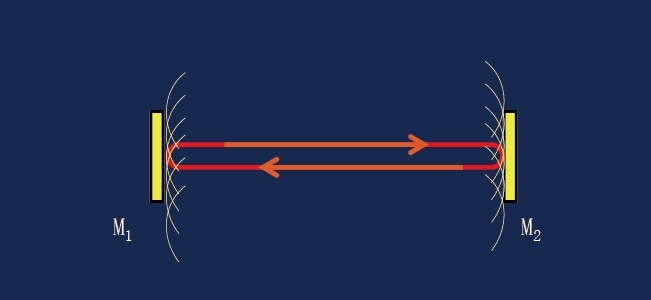
According to the wave theory, the propagation of light in the resonator is a diffraction process, and since the resonator cavity mirror always has a finite size, a small amount of light is lost from the edge of the mirror each time it is diffracted . The magnitude of the loss caused by diffraction is directly proportional to the cavity length and laser wavelength, and inversely proportional to the area of the cavity.
Scattering and absorption losses
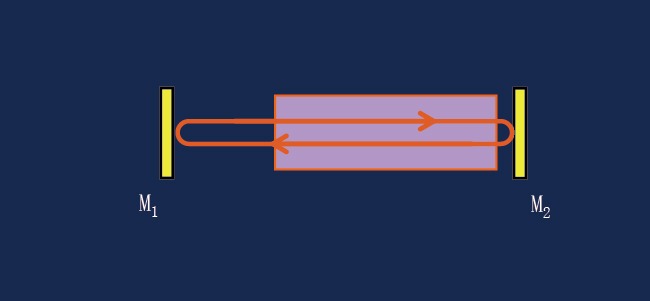
The scattering and absorption losses of the working substance, the magnitude of the average one-way loss factor of this loss, can be obtained from the loss coefficient of the working substance.
Accessory loss of the component
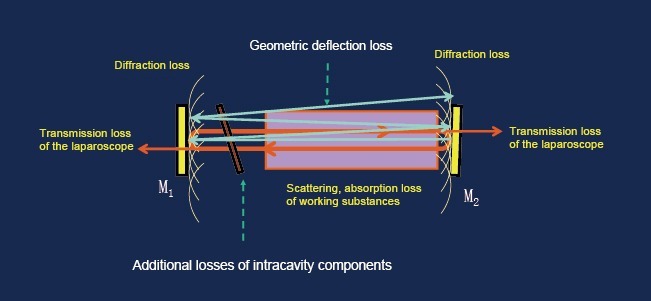
In addition to the three necessary components of a laser, we usually insert some optical components into the resonator cavity to change or control some characteristics of the laser. Typical devices include Q-switches, F-P etalons, regulators, frequency doubling crystals, gratings, filters, and diaphragms. When light passes through these additionally inserted optical elements, additional losses are generated due to emission from the surface of the element, scattering and absorption of materials, etc., which are called accessory losses. The more elements are inserted into the cavity, the greater the loss.
There are roughly 5 types of losses in the resonator, and the sources of these 5 types of losses are different, and these losses can be analyzed separately, and the total average single-pass loss factor of the resonator can be obtained by adding their average single-pass loss factors.
Be the first to comment