
Laser mirrors are defined as high-quality mirrors used in laser resonators and other optical devices.
The resonator of the laser contains a mirror, which must meet the following requirements:
- Low reflection loss with clear transmission over a wavelength range for highly reflective mirrors or output couplers.
- High-quality optical surfaces that avoid wavefront distortion, which can degrade beam quality.
- Good resistance to high light intensity to avoid laser-induced damage (especially in Q-switched lasers), i.e. high damage threshold.
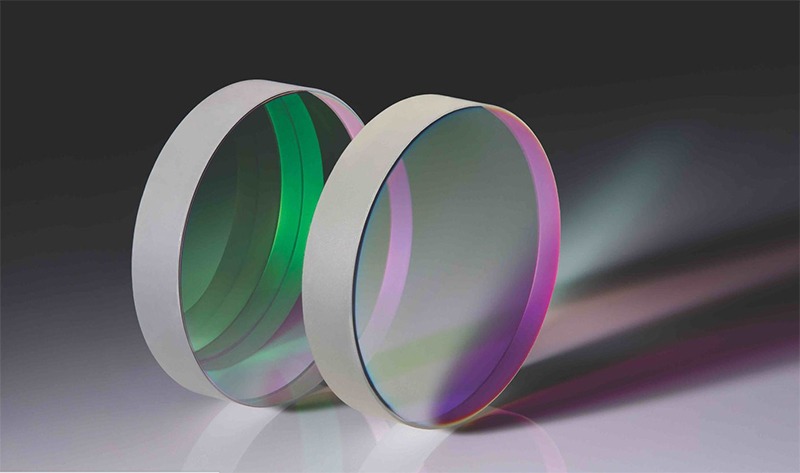
In almost all cases, dielectric mirrors based on multilayer structures (mainly quarter-wave mirrors) act as laser mirrors. Typically, one of the mirrors acting as an output coupler transmits significant laser radiation, while all other mirrors are highly reflective (with a reflectivity of >99.9%). Some mirrors can also be made into dichroic mirrors, allowing pump light to be injected into the gain medium of the end-pumped laser, and for some quasi-tri-level lasers, the requirements for such dichroic mirrors can be high due to the very close proximity of the pump wavelength and the laser wavelength.
Of course, laser mirrors can also be used to reflect light outside the laser resonator. For example, a pair of steering mirrors are typically used, each of which deflects the beam ≈ 90° and is used to feed the laser beam into certain instruments. The mirror holder of the steering mirror usually has two or three adjustment screws that adjust the virtual origin and direction of the beam.
Surface
For most laser mirrors, the surface quality in terms of local defect density is particularly important. This is mainly to avoid beam distortion, especially in lasers designed to diffraction to limit the quality of the output beam.
In addition, people often quantify the tolerance of surface irregularities, which is related to the retention of the wavefront; For example, for some lasers, an irregularity of λ/2 may be sufficient, while for others an irregularity of λ/8 or better is required.
Note, however, that a meaningful specification requires more conditions:
- It is important to know whether these values refer to the wavefront at the time of surface or reflection, as the resulting wavefront error is twice as large.
- You need to know whether the specified number is a peak-to-peak or an r.m.s. value.
- In addition, it is important to note whether these figures are typical or minimum standard values.
Impairment threshold
Primarily for Q-switched lasers, the laser-induced damage threshold is important. Some lasers are designed to involve particularly high light intensities on resonator mirrors and can only work with mirrors with exceptionally high damage thresholds. This can be achieved by selecting the appropriate coating material and a high-quality manufacturing process. Note that even for a given material, the damage threshold can be greatly reduced due to impurities or microscopic defects.
Residual Transfers
Even highly reflective laser mirrors will exhibit some residual transmission. This is especially true for high-power lasers, which can result in an additional output beam with considerable power, and is sometimes used for diagnostic purposes, such as monitoring laser power without using part of the output beam. The problem may come from the non-uniformity of the residual transmission, which can be strong for highly reflective mirrors.
Dichroic
Many laser mirrors only require high reflection of the laser wavelength. However, in some cases, additional properties are required, such as high transmittance of pumped light at shorter wavelengths. Dichroic mirrors with more complex film designs are then required. For example, Figure 2 shows the reflection spectrum of a short-pass mirror, which can be used for end-pumped Nd:YAG lasers: for example, 808 nm pump light is well transmitted, while 1064 nm laser is fully reflected.
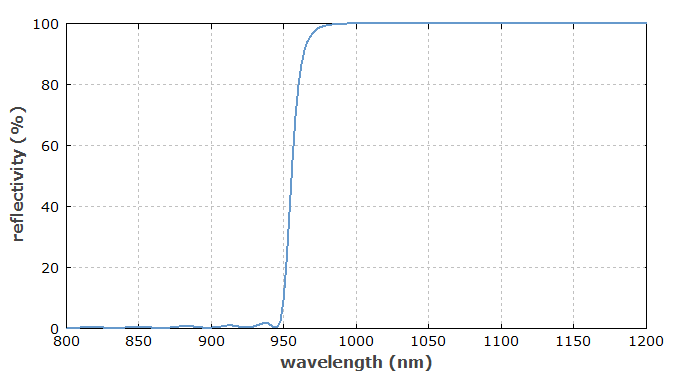
In other cases, it is necessary to have high resonator losses on unwanted laser lines. If there is a mirror in the resonator with high transmittance sufficient to suppress strong laser lines at 1064 nm, then the Nd:YAG laser can operate at 946 nm.
Mirror substrates
Typically, laser mirrors are manufactured on the basis of a mirror substrate made of glass (e.g. BK7 or fused silica) or glass ceramics, but mirror coatings can also be deposited directly on the laser crystal (or glass), e.g. for monolithic lasers. A typical mirror substrate is cylindrical, with a diameter of 1 inch (≈ 25.4 mm) or 0.5 inches and a thickness of 6 mm. Even for highly reflective mirrors, certain substrate properties are important, particularly surface quality, along with high hardness, low coefficient of thermal expansion, and/or high thermal conductivity (to avoid thermal expansion of high-power lasers). For some transmissive mirrors, high optical homogeneity (avoiding beam distortion of transmitted light) and low absorption and scattering losses are also required.
The surface of the mirror substrate may be curved, allowing the laser mirror to focus or defocus. Assuming a perpendicular incidence, the effective focal length is half the radius of curvature. For strong curvatures, such as a radius of curvature well below 10 mm, it is difficult to obtain high-quality mirror coatings. In general, high-quality mirrors with a radius of about 1 mm can be manufactured.
Laser mirror holder
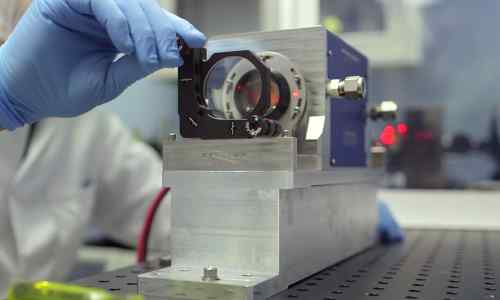
Laser mirrors are usually placed on adjustable brackets, and by turning two or three adjustment screws, the laser resonator can be aligned. The high-quality bracket allows for a stable installation while applying only a small amount of mechanical stress to the mirror substrate and shows a long-term stable mirror orientation, virtually unaffected by temperature changes.
The laser mirror, which is part of the diode-pumped laser cavity, is placed on an adjustable frame. The adjustment screws allow people to align the laser resonator.
Special mirror types
Special types of dielectric mirrors, such as chirp mirrors (or other types of dispersion mirrors), can also provide the appropriate amount of dispersion in the resonator of mode-locked lasers. This avoids the use of prism pairs and allows for the construction of fairly compact femtosecond lasers.
There are also super mirrors with very low reflection losses, but they are rarely used in laser resonators, but instead for special applications, such as building resonators with a very high Q factor. Metal-coated mirrors, such as silver mirrors, are generally not suitable for use in laser resonators because they have higher reflection losses and are not suitable for use as output couplers. In addition, the surface of this mirror is susceptible to oxidation, which reduces the surface quality and reflectivity.
Be the first to comment