
Laser has good monochromaticity, but is it absolutely singular in frequency? Let's make a brief analysis of this problem. Because the theoretical calculation value of the laser line width is far from its actual line width, it is only a certain explanation of the laser line width, and no further quantitative theoretical calculation is made.
Theoretically, it is said that the spectral lines emitted by ordinary light sources have a certain width. There are many reasons for line width, the most important of which are: the finite lifetime of the energy level causes the natural width of the line; The collision between the luminous particles results in the collision width (or pressure width) of the noll line; The thermal motion of the luminous particles results in the Doppler width of the Heliopoly. These three situations generally work at the same time, and the actual linetype is the result of their combination. Such spectral lines are called fluorescence spectral lines of luminescent substances, and their line widths are called fluorescence line widths.
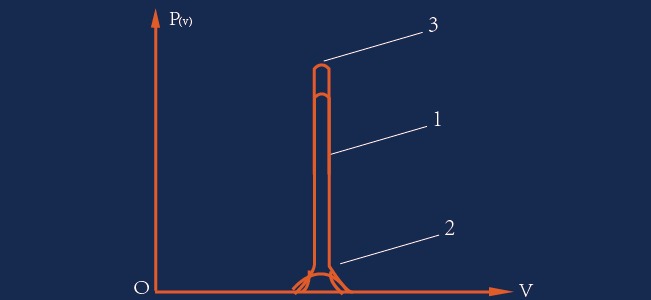
For a laser, when it is operating steadily, its gain is exactly equal to the total loss. At this time, the ideal situation is: the energy lost in the cavity is replenished in the process of stimulation, and the light wave generated in the stimulus process has the same phase as the original light wave, so the newly generated light wave is coherent and superimposed with the original light wave, so that the amplitude of the light wave in the cavity is always kept constant, and accordingly there will be an infinite wave train, so the line width should be "%". If the laser is single-mode input, then the spectral line it outputs should be a "line" in the range of fluorescence line width A*, as shown in Figure 3-16.

Causes of laser line width
In fact, the line width cannot be equal to "0". Although the spectral lines of the laser are extremely narrow, they still have a certain width. There are many reasons for laser line width.
- The first is the internal reason: the spontaneous emission of the activation medium is completely ignored in the ideal laser. An actual laser, although its spontaneous emission is extremely weak relative to stimulated radiation, is still unavoidable, and it also dedicates a very small share of the output power of the laser. This share is the incoherent radiated power, while the stimulated radiation process contributes the coherent radiated power.
- The gain of the laser will include the contribution of the stimulus process and the gate process. When the oscillation reaches equilibrium, the energy in the laser is balanced, and the sum of the stimulated radiation gain and the spontaneous radiation gain of the medium is equal to the total loss of the cavity, so the gain of stimulated radiation should be less than the total loss. In this way, for the coherent light of stimulated radiation, there is a certain attenuation in each wave train, and it is this attenuation that causes a certain line width, which
- On the other hand, the spontaneous radiation in the cavity produces columns, wave trains that are phase-independent before and after the columns, and these wave trains are related to the phases. The light intensity of the wave train is superimposed, so that the light intensity in the cavity remains stable. Such a number of independent spontaneously emitting wave trains also cause a certain line width. The above two factors cause the laser line width caused by the presence of spontaneous emission is one of the problems.
- If the output power of the laser increases, it means that the energy density of the radiation field in the cavity also increasesr, and the probability of stimulated radiation is proportional to the energy density of the radiation field, but the rate of spontaneous radiation does not change, so the proportion of stimulated radiation increases correspondingly, and the width of the laser oscillation line also narrows accordingly. This means that increasing the output power of the laser can reduce the laser linewidth due to spontaneous emission. Theoretical calculations show that the laser linewidth is inversely proportional to the laser output power.
- Theoretical calculations also point out that the width of the laser line caused by the spontaneous emission in the cavity alone is much smaller than 1Hzo, for example, the cavity KL=1m, the one-pass loss is 75%, and the width of the 0.6328 moan line emitted by a He-Ne laser with an output of 1mW at each end is about 5x10"Hz, which is an extremely small line width.
The experimental laser linewidth is much larger than this value. This suggests that there are other factors that contribute to the laser linewidth that are more influential than spontaneous radiation. Nevertheless, the analysis of laser linewidth due to spontaneous emission is of great interest. Because spontaneous emission is present in any laser, the laser linewidth caused by this factor cannot be ruled out. In other words, this line width is the minimum line width that can be achieved after eliminating various other factors that increase the laser line width, so it is called the line width limit.
Influencing factors
Some factors that affect the stability of the laser, such as temperature fluctuations, mechanical vibrations, changes in atmospheric pressure and humidity, air convection, loss fluctuations, gain fluctuations, and fluorescence center frequency drift, are external causes of laser line width.
Because when the frequency of the laser is unstable and changes and drifts, the laser oscillation will not be a continuous sinusoidal oscillation of equal amplitude, and it will inevitably form a certain frequency distribution, so there will be a certain spectral line width. Experiments show that the output line width of He-Ne laser with high frequency stability is about the order of tens of Hz, the ordinary He-Ne laser can reach about 104Hz (its fluorescence line width is about 109Hz), and the spectrum width of solid-state laser and semiconductor laser is wider, generally above IO6Hz.
Be the first to comment