
Definition of Laser Crystals: Transparent crystals with a laser active dopant used as a laser gain medium, more general term: laser gain medium.
Laser crystals are optical crystals, usually single crystals (single crystal optical materials) that are used as a gain medium for solid-state lasers. In most cases, they are doped with trivalent rare earth ions or transition metal ions. When crystals pass by absorbing the energy provided by pumped light (optical pumping), these ions enable the crystals to amplify light at laser wavelengths through stimulated radiation.
Compared to doped glasses, crystals typically have higher transition cross-sections, smaller absorption and emission bandwidths, higher thermal conductivity, and possible birefringence. In some cases, the single crystal laser material may be replaced by a ceramic laser gain medium, which has a fine polycrystalline structure.
Common laser active dopants
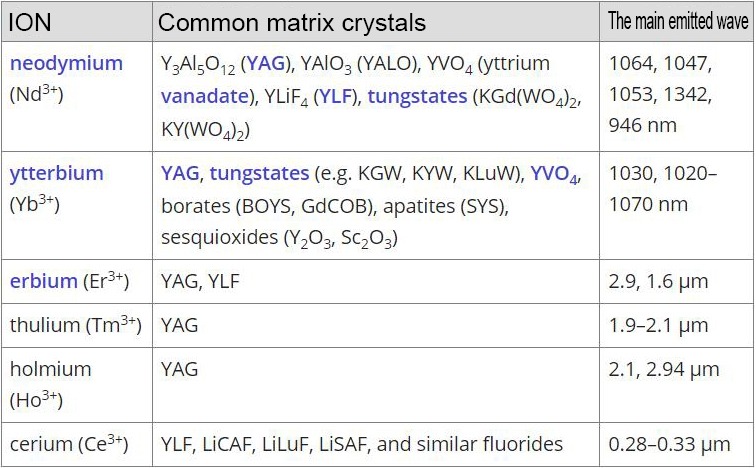
The most commonly used laser-active rare earth ions and matrix crystals and typical emission wavelengths are shown in the table below:
The following table lists common transition metal doped crystals:
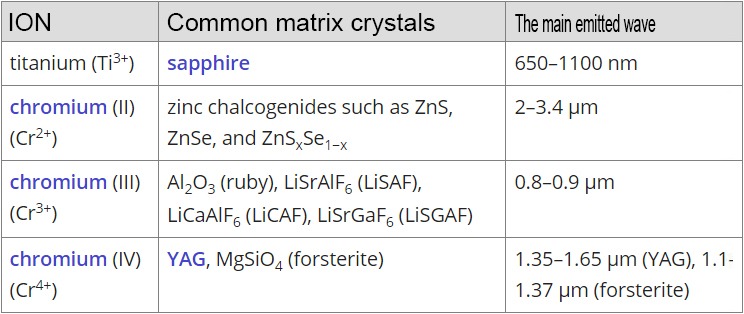
These tables contain only the most common matrix crystals; There are many other matrix crystals, but they are used less frequently.
Important properties of matrix crystals
- Matrix crystals are more than just a means of fixing laser active ions at specific locations in space. Some properties of the host material are important.
- The medium should have high transparency (low absorption and scattering) in the wavelength range of pump and laser radiation, as well as good optical homogeneity. To some extent, it depends on the quality of the material, which is determined by the details of the manufacturing process.
- The matrix crystal has a great influence on the wavelength, bandwidth, and transition cross-section of the pump and laser transitions, as well as the upper energy state lifetime. For example, Nd:YVO 4 has a higher cross-section, greater gain bandwidth, and shorter up-level lifetime compared to Nd:YAG. Other neodymium-matrix crystals offer other transition wavelengths, e.g., 1047 or 1053 nm for Nd:YLF.
- Non-radiative transitions, such as multiphonon transitions, are also strongly influenced by the substrate, especially by its maximum phonon energy. Some of these transitions are very harmful and can lead to the quenching of particles in the upper energy state (thus reducing quantum efficiency).
- The maximum possible particle doping depends largely on the substrate material and its manufacturing method.
- Different crystalline materials vary greatly in terms of hardness and other properties, which determines what method and how simply they are cut and polished with high quality.
- Some materials are chemically unstable, such as hygroscopicity.
- Especially for high-power lasers, high thermal conductivity, low thermo-optical coefficient (for weak thermal lenses), and high mechanical stress tolerance are required.
- A high damage threshold in terms of pulse energy density or peak intensity is important for high-energy amplifiers.
It is clear that different applications result in completely different requirements for the laser gain medium. For this reason, a wide variety of different crystals are used, and making the right choice is essential to build a laser with the best performance.
Crystal matrix of common lasers
Crystal matrices have a wide range and can be grouped according to important atomic components and crystal structures. Some of the important crystal groups are:
- Garnets such as Y3Al5O12 (YAG), Gd3Ga5O12 (GGG) and Gd3Sc2Al3O12 (GSGG): hard, chemically inert materials with optical isotropy and high thermal conductivity.
- Sapphire (Al2O3) (e.g. for titanium-sapphire lasers) and aluminates such as YAlO3 (YALO, YAP) for neodymium-doped: high hardness and high thermal conductivity, anisotropic.
- Sesquioxides, e.g. Y2O3, Sc2O3: isotropic, high hardness and high thermal conductivity.
- Vanadates such as YVO4 and GdVO4:Nd3+ have very high laser cross-sections and are anisotropic.
- Fluoride, such as YLF4 (YLF): Nd:YLF has good ultraviolet transparency, birefringence, and large energy storage capacity; LiCAF, LiLuF, and LiSAF can also be used as chromium-doped broadband gain media.
- Silicates, such as MgSiO4 (forsterite): Wide gain bandwidth.
- Monoclinic ditungstatetes, such as KGd(WO4)2 (KGW) and KY(WO4)2(KYW): combine a relatively high Yb 3+ laser cross-section, a large gain bandwidth, and high thermal conductivity.
- Disordered tetragonal bistungstatetes, such as NaGd(WO4)2(NGW) and NaY(WO4)2(NYW): Ytterbium has a particularly large gain bandwidth.
- Calcifications for mid-infrared lasers, such as ZnS or ZnSe.
可饱和吸收器的激光晶体
Some laser crystal materials have been demonstrated, with the addition of some saturable absorbent materials for the passive Q switching of lasers. For example, Cr4+ ions can be added to this neodymium-doped crystal for emission in the 1 μm spectral region. This has been tried in Cr:Nd:YAG and Cr:Nd:YVO4, for example.
With this concept, there is no need to add saturable absorption crystals, which makes it possible to create more compact Q-switched laser setups with reduced internal additional losses. However, unwanted side effects such as obtaining an unnecessary valence state or energy transfer of the ions involved can also occur. In addition, it is not possible to experiment with absorbers of different thicknesses or doping concentrations without replacing the laser crystal itself, and some flexibility is lost in the experiment.
The geometry of the laser crystal
Those surfaces that are passed by the laser beam are usually oriented at a Brewster angle or have an anti-reflective coating. Even anti-reflection coated crystals are usually slightly tilted against the beam to prevent back-reflections from remaining in the laser resonator. This is important for mode-locked lasers and tunable single-frequency lasers.
High surface quality is also very important, and surface flatness specifications are often better than λ/10. This helps to avoid scattering losses and wavefront distortion that can degrade the laser beam quality. Proper surface treatment can also affect the damage threshold, which is important, e.g. for high-energy pulse amplifiers. Finally, a high degree of end-face parallelism is important to avoid changes in beam direction in the crystal.
Be the first to comment