
The threshold pump power of a laser refers to the pump power value at which the laser threshold is just reached, and is usually assumed to be a steady-state condition. In this case, the small signal gain is equal to the loss of the laser resonator. Similar thresholds exist for some other types of light sources, such as Raman lasers and optical parametric oscillators.
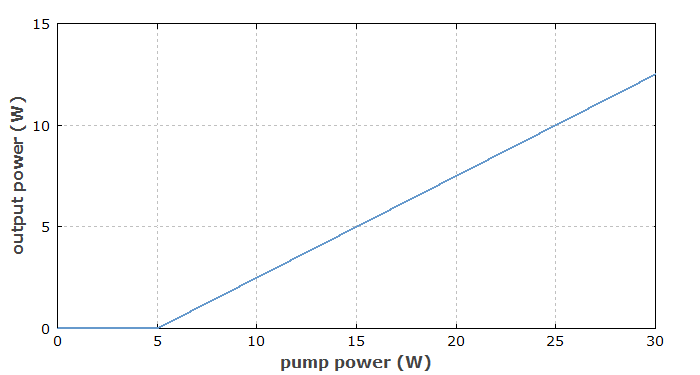
The threshold pump power is 5W and the slope efficiency is 50%. Due to the effect of amplified spontaneous radiation, the "edges" that appear at the threshold are very rounded.
For optically pumped lasers, the threshold pump power may be defined based on incident or absorption pump power. For an application, the incident pump power may make more sense, but the threshold power may be more meaningful relative to the absorbed power, for example, to judge the gain efficiency of the gain medium.
Low threshold power requires low resonator losses and high gain efficiency. High gain efficiency is achieved by using a small laser mode region in the gain medium with a high σ-τ product. High gain efficiency is fundamentally limited by the emission bandwidth, so broadband gain media tend to have high laser thresholds.
For a simple four-level laser gain medium, we can use the gain efficiency equation to calculate the threshold pump power:
Pp.th = lrt/(dg/dPp) = (hvp*A*lrt)/(ηp*τ2*σem)
where lrt is the round-trip loss power of the laser resonator (taking into account the output coupler losses and additional losses), hvp is the photon energy of the pump source, A is the beam area in the laser crystal, ηp is the pump efficiency, τ2 is the upper energy state lifetime, and σem is the emission cross-section. The power loss per round trip is assumed to be lrt, so the round-trip gain is small (e.g. less than 20% or 1dB). If the pump efficiency is defined accordingly, the equation can be used for pump thresholds in relation to incident or absorbed power.
Optimization of laser output power for a given pump power typically involves a trade-off between high slope efficiency and low laser threshold power. Typically, the pump power used in normal operation is several times higher than the pump threshold power. Which value is best suited for the threshold pump power is one of the issues in laser design.
The dependence of the output power of the laser on the pump power is not always as simple as shown in Figure 1. For example, in some lasers with high resonator losses, the start of the laser may not be as clear. The threshold pump power is sometimes defined by extrapolating the approximate linear curve at higher power to zero.
There are some special types of lasers, such as single-atom lasers, which do not have a laser threshold and are therefore called threshold-free lasers.
Be the first to comment