
The threshold of a laser is a state in which the small-signal gain is just equal to the resonator loss so that the laser can start firing. This is the case of a specific pump power (threshold pump power) or (for electrically pumped lasers) a specific threshold current. Significant power output, good power efficiency, and consistent low-noise performance require operation well above the threshold energy. Typically, the laser is run between 3 and 10 times above the threshold.
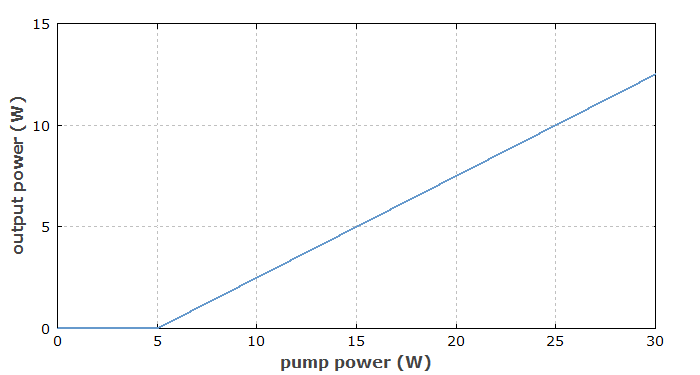
Depending on the requirement that the small-signal round-trip gain is equal to the level of laser wavelength round-trip power loss, the threshold pump power can often be easily calculated. For an example, see the article on threshold pump power.
The low threshold power requires lower resonator losses and high gain efficiency, the latter being achieved by using a small laser mode area in a highly efficient gain medium with limited emission bandwidth. In the case of a given pump power, the optimization of the laser output power usually involves a trade-off between high slope efficiency and low laser threshold. The overall optimization of laser performance may have to consider other aspects, such as the pulse duration achievable in a Q-switched laser, avoiding Q-switching instabilities in a mode-locked laser, or minimizing thermal effects. Which value is best suited for the threshold pump power is one of the issues in laser design.
Even for operations below the laser threshold, the gain medium emits cold light (for optically pumped lasers, this can be referred to as fluorescence). Above the threshold (in CW operation), the luminous intensity level is typically clamped to a value close to the laser threshold (gain clamping). Below the threshold, the laser also emits some power from amplified spontaneous emission with a bandwidth that is larger than that of a laser above the threshold, but smaller than the conventional luminous bandwidth.
The basic source of the laser threshold is the power loss that enters a large number of spatial patterns (propagating in all directions) by emitting light. In some cases, threshold-free lasers can be obtained by suppressing luminescence through microcavities. This can be achieved, for example, based on the principle of the photonic band gap in a photonic crystal.
Most lasers are pumped at only a few times the threshold pumping power, which is ideal, and lower thresholds do not significantly improve efficiency, but may introduce problems associated with, for example, excessive intracavity intensity.
Be the first to comment