
A laser transition (or amplifier transition) is a transition between two levels of electronic energy of certain laser active ions, such as optical amplification by stimulated emission, which can be used in optical amplifiers or lasers.
In general, certain optical transitions can be considered valid laser transitions if the following conditions are met:
- The upper layer must be filled strongly in some way, for example, by light pumping.
- Ideally, stimulated emission from high to low energy levels is the dominant process, and any additional radiative and non-radiative transitions will be relatively weak. Quantitatively, the upper-energy state lifetime will be large compared to the reverse stimulated emissivity.
- There should be a mechanism that allows for a rapid reduction of the lower laser energy levels upon excitation, so that the reabsorption of this transition does not have a strong effect.
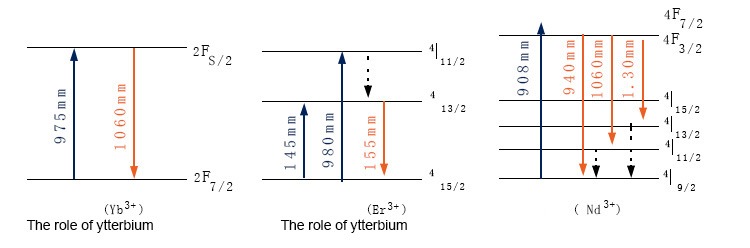
Figure: Energy level maps of various laser active ions for important pump (blue) and amplifier (red) transitions. And each horizontal line represents a complete Stark horizontal manifold, which also contains multiple Stark levels. The energy level and transition wavelength determine the host material to some extent, while the dotted line represents a fast non-radiative multiphonon transition.
One of the forms in which the laser transition manifests:
Some laser gain media provide a laser transition with almost desirable characteristics, e.g., neodymium ions in Nd:YAG exhibit a transition from an upper Stark manifold 4F3/2 to a lower manifold 4I11/2. The wavelength of 1064 nm is stimulated and effective pumping takes place, at about 808 nm (despite the obvious quantum defects), because the spontaneous emission from the upper energy is quite weak (due to the narrow emission bandwidth) and the lower energy is rapidly reduced by multiphonon transitions.
The second form of laser transition manifestation:
The last condition of the quasi-three-level laser transition medium cannot be perfectly satisfied, because the lower energy levels belong to the ground state manifold, such as the 1030-nm and 1050-nm transitions in Yb:YAG and the 946-nm transition from 4F3/2 to the ground state manifold 4I9/2 in Nd:YAG, the reabsorption generated by the laser transition tends to increase the threshold pump power, but on the other hand, this transition not only has a fairly low strength quantum defect, so the laser design is optimized accordingly, which will result in effective laser operation.
Be the first to comment