
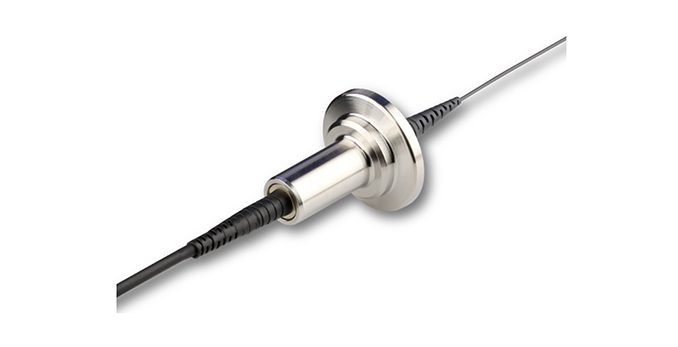
A fiber optic cable (or fiber optic cable) is a more or less flexible cable that contains one or several (sometimes hundreds) of optical fibers. Fiber optic cables are stronger than bare fibers because the protective layer (made of polymer or made of metal) protects against damage caused by excessive bending and externally applied stresses, and of course fiber optic cables protect the fiberglass from moisture.
Advantages and disadvantages of different fiber optic cables:
- Simple coated fibers (referred to as bare fibers despite coatings) in which a single glass fiber is surrounded by a polymer coating, which is typically 250 μm in diameter (twice the diameter of the fiber). For fibers in some optics, this low level of protection is generally sufficient;
- Tightly buffered fibers in which a thicker polymer buffer layer (900μm outer diameter) protects the fiber. Buffers can protect the fiber from excessive bending, but it does not have a great effect on stretching. This buffered fiber can be integrated into the fiber optic cable, especially for indoor use, with good protection, such as: yellow (clearly visible) thick polymer layer;
- Sometimes one or more tightly cushioned cables can be packaged into larger cable structures to provide additional protection, such as using aramid yarn, tear cord and an outer sheath (made of PVC) with a strength element around which the fibers are placed. (When pulling the fiber, it should be pulled to the reinforcement, not to the protective sleeve.) This type of partial fiber is used as a distribution cable within the building, and the other part is called a breakout cable or fan-out cable, which contains a single fiber in multiple distribution cables that is a smaller cable; Generally larger and more expensive than distribution cables (fiber optic cables even contain hundreds of glass fibers);
- Two single-wire cables can be combined to form a duplex cable – generally used for separate optical fibers to transmit data signals in both directions;
- Ribbon cables consist of multiple fibers (typically 12) side by side, forming a flat ribbon. Multiple ribbons can be placed on top of others, and the geometry can be filled with high densities;
- Fiber bundle cables contain a large number of smaller fibers for lighting or imaging applications, and such beams can be ordered ("coherent") or disordered;
- Loose tube fiber optic cables consist of one or more coated optical fibers loosely placed in a semi-rigid plastic tube (in air or in a moisture-proof gel). Loose tubes (or loose tubes) can be surrounded by additional layers such as water-blocking wraps and outer sheaths (made of generally polyethylene). The structure also contains a metal sheath for increased mechanical strength. Overstretching of loose tube cables can damage the glass fibers, so loose tubes contain a portion of the excess length of fiber. Usually there is little influence from external factors, which of course contributes to the formation of polarization mode dispersion. This protection is sufficient for outdoor use. However, loose tube cables are not very convenient in connection and are not suitable for installation in vertical pipes;
- Armoured fiber optic cables have an additional outer armor layer for further protection, and they are suitable for direct burial, or overhead arrangement, or in outdoor pipes;
- Submarine cable equips can be used in fresh or salt water, they must be protected from heavy mechanical stresses such as from anchors or fishing equipment;
- Some cables contain special optical fibers, such as fibers with hollow photonic crystals, which are used to transmit strong ultrashort optical pulses.
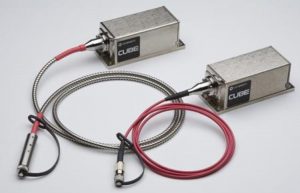
Figure 1: Photograph of a fiber-coupled diode laser from Coherent with different kinds of fiber optic cables.
Disadvantages of fiber optic cables:
- For indoor cables, fire safety is an important aspect, while for outdoor cables, moisture and temperature resistance are an important factor. Special overhead/self-supporting cables can be exposed to air, wind, sunlight (suspended from poles), but must be guaranteed to have particularly high tensile forces and overall robustness, and some steel or aramid yarn is used. Of course, outdoor cables can not only adapt to indoor conditions, but they are not allowed to be used indoors due to non-fire reasons (or some restricted reasons);
- The structure of fiber optic cables is relatively complex and should be optimized for strength, diameter, weight, fire resistance, cost, and other related characteristics. For example, mechanical details can have an effect on polarization mode dispersion;
- The terminations (ends) of fiber optic cables are usually equipped with fiber optic connectors, so that simple insertion is the same as a cable. But fiber optic connections are often more sensitive than electrical connections and require more complex procedures and equipment to maintain or clean them;
- Various types of fiber optic patch cords (patch cords) can be used, and they are terminated with standardized fiber connectors;
- Long-distance cables are made by connecting multiple cables, each of which is several kilometers long. Stable connections can be made with splicing, especially with welding.
NEC Fiber Optic Cable Classification
- OFC cables are conductive (C) fiber optic cables, i.e., cables that contain metal in a reinforced structure (not used for electrical connections). In contrast, OFN cables do not conduct electricity, so they are insulators;
- Riser cables with additional "R" (e.g. OFCR or OFNR) are used for connections between different levels of the building (vertical shafts). They are optimized so that the spread of fire varies from floor to floor;
- Pressure ventilation cables with additional "Ps" (e.g., OFCP or OFNP) are used for pressure ventilation or air handling spaces – e.g. cables for routing along ceilings or ventilation ducts. When exposed to fire, they do not produce excessive smoke and are also flame retardant;
- Universal cables are marked with a "G", such as OFCG or OFNG.
The above code does not specify the optical properties of the included fibers; These can be any type of single-mode or multimode fiber.
Other factors of cable specifications:
- For telecom optical fibers, ITU has developed standards such as "G.651.1"; They meet such specifications;
- The Fiber Distributed Data Interface (FDDI) is a standard for LAN fiber optic cables, but due to the increased availability of advanced copper cables, transmission speeds are very limited, with only 100 Mbit/s already out of date;
- For graded index fibers, there are other classifications such as: OM1, OM2, OM3, OM4, and OM5, which involve residual levels of intermodal dispersion. This limits the cable's transmission bandwidth (or bandwidth-distance product). High performance is achieved by OM4 50/125-μm laser-optimized fibers with very precisely controlled refractive index distribution;
- Sometimes, the bandwidth-distance product (in MHz·km) is realized;
- Specifications such as "50/125 microns" indicate core and cladding diameters. The large value of the core diameter (tens of microns) usually indicates a multimode fiber;
- Propagation losses are usually specified in dB/km (dB per km). These applications do not bend the cable, so only some degree of microbending loss occurs in addition to absorption and scattering losses.
Applications of fiber optic cables
Fiber optic cables are commonly used for fiber optic communications. Not only large but also robust cables can be used for data transmission over land, and it is also possible to bridge distances of thousands of kilometers (using fiber amplifiers). Smaller fiber patch cords can be used to connect components that connect fiber optic data links within a building. The main advantages of fiber optic cables over data cables are the huge transmission bandwidth and the ability to resist electromagnetic interference (especially in the 1.5 micron wavelength range) and to be completely insulated cables.
Today, many fiber optic cables for data transmission have been laid, but are not yet used or are not being used. Because it is much cheaper to bury fiber when the underground channel is opened, people prefer to use fiber optic cables in the ground without risk.
There are also many "dark fibers" in fiber optic cables, i.e. fibers that are (not yet in use). They may be kept for future needs.
In laboratory and industrial settings, fiber optic cables are often used more easily to transmit light from a light source to applications such as from high-power fiber lasers to welding robots in automotive factories, or from optical sampling heads to measuring instruments, for short distances of low optical power.
Be the first to comment