
Atoms or ions have different electron energy levels, and the transitions between these energy levels usually involve the emission or absorption of light (photons). Absorbed photons can transfer energy for atoms or ions to bring them to higher energy levels, while spontaneous or stimulated emission releases energy previously stored in atoms or ions, a transition that can be used as a laser transition in a laser gain medium.
The likelihood of such a transition depends on the electron energy levels involved. Strong transformations are those that satisfy certain selection rules. For example, a dipole transition can only occur between energy levels where the angular momentum parameter l is 1 phase apart. Therefore, dipole jumps between energy levels with the same parity are forbidden. Assuming that the approximation of the LS coupling is exact, then some "less strongly forbidden" transformations are forbidden.
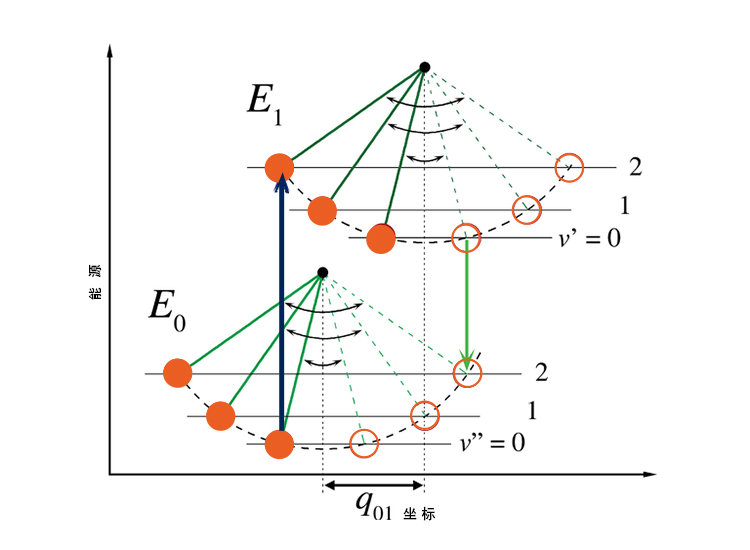
However, based on other mechanisms, such as quadrupole jumps, dipole forbidden jumps between energy levels may occur. In addition, for ions embedded in a lattice or glass, internal electric and magnetic fields break their symmetry, so that the mixing of states with different parity, such as the initial prohibition of the transition of the dipole from occurring. However, such processes are generally unlikely, as they exhibit small oscillator strengths. The resulting transition is sometimes referred to as a weaker permissible transition, rather than a forbidden transition. It is precisely because of such a transition mechanism, although not very strong, that the typical high-state lifetimes will be in the order of a few nanoseconds when spontaneous emission transitions are allowed, and the forbidden transitions of isolated atoms or ions can have a high-energy state lifetime of a few milliseconds or even a few seconds, while for ions in crystals or glass, generally between a few microseconds and a few milliseconds, this long-standing horizontal state is called metastability.
Transitions in solid-state laser gain media
Essentially, all laser transitions in solid-state lasers doped with insulators (as opposed to semiconductor lasers and color center lasers) are weaker permissible transitions achieved by an internal electric field. The low transition rate results in a long upstate lifetime, which results in a large amount of energy storage, which is the basis for the generation of pulses via Q switching, and the combination of upper-state lifetime and low transition cross-section also leads to spikes and significant relaxation oscillations in such lasers.
Weaker spontaneous radiation
Note that the achievable gain of a forbidden jump will not necessarily be lower than the gain of a permissible jump, as spontaneous emissions are also weaker.In summary, although the emission cross-section σ is smaller, the product of the σ -τ is likely to be larger, because the weaker transition allows for a higher upper-energy state lifetime τ.
Transitions of the light clock
Forbidden transitions of isolated atoms or ions are used in optical clocks (clock transitions). Here, the long upper-energy state lifetime is important because it results in an extremely narrow line width of the transition, so the transition frequency is very well-defined. Unfortunately, however, low conversion rates can also make it more challenging to explore transitions.
Be the first to comment