
Laser marking and coding technology has been around for nearly 50 years. During this time, advances in engineering technology have resulted in different laser marking systems for different applications. The white paper explains the technology behind the laser marking system and the options available to businesses. With a better understanding, readers will be able to make an informed choice when choosing the right laser marking system for their application.
History
The word "laser" has become so much of our everyday vocabulary that we tend to forget that it is an abbreviation derived from the rather complex description "Light Amplification by Stimulated Emission of Radiation".
Lasers have always been considered a new technology, but in reality they have been around longer than we think. The laser theory was proposed in 1957, and the first laser was manufactured in 1960. Long before that, at the turn of the century, Albert Einstein proposed an equation that describes the main physical mechanisms by which laser action occurs; Although he didn't realize the value of lasers at the time.
Many companies and government agencies have become interested in lasers and have started to develop their own lasers without any specific application, and as a result, lasers have been called "finding solutions to problems". Today, lasers are developed for specific tasks and their characteristics are designed to meet the requirements of the application.
Lasers are probably one of the most widely used devices of any type, including cutting and welding metals, surgical procedures, data reading and transmission, holography, precise measurement of physical parameters, non-destructive testing, and marking products on the production line.
Laser marking systems have been on the market for about 50 years, and these early systems were based on scientifically researched lasers and were not designed to be used in wet and harsh factories and could not achieve 24/7 continuous operation. As a result, the initial focus was on making these devices more robust and durable, rather than developing new technical formats to respond to changing market demands.
How lasers work
All lasers share the same basic principle, but differ depending on how the product is designed, the materials used, and the characteristics of the laser output beam.
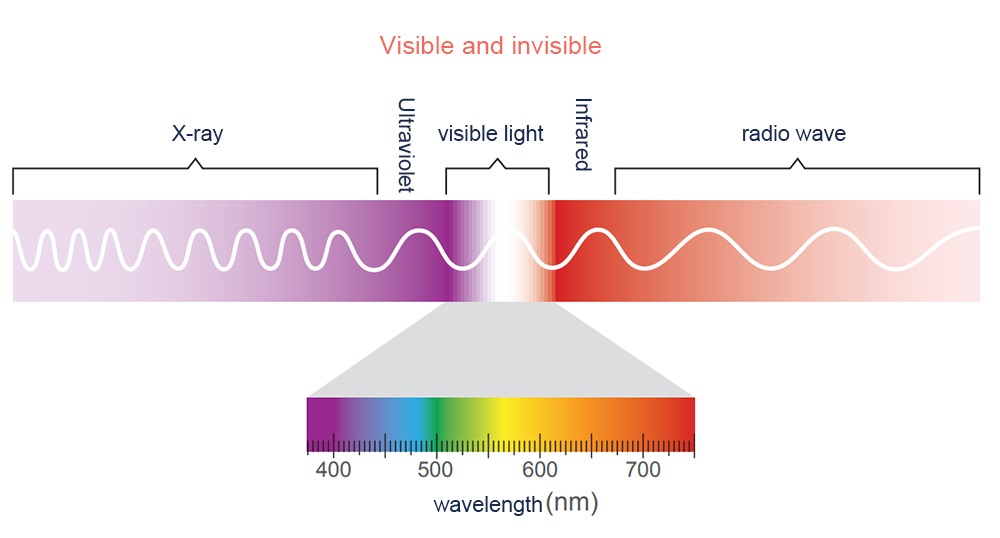
Lasers used for product marking occupy the infrared range of the electromagnetic spectrum, from 10600 nm for CO2 lasers to 1055 – 1070 nm for ytterbium-doped fiber lasers, compared to the 671 nm diode laser that occupies 671 nm.
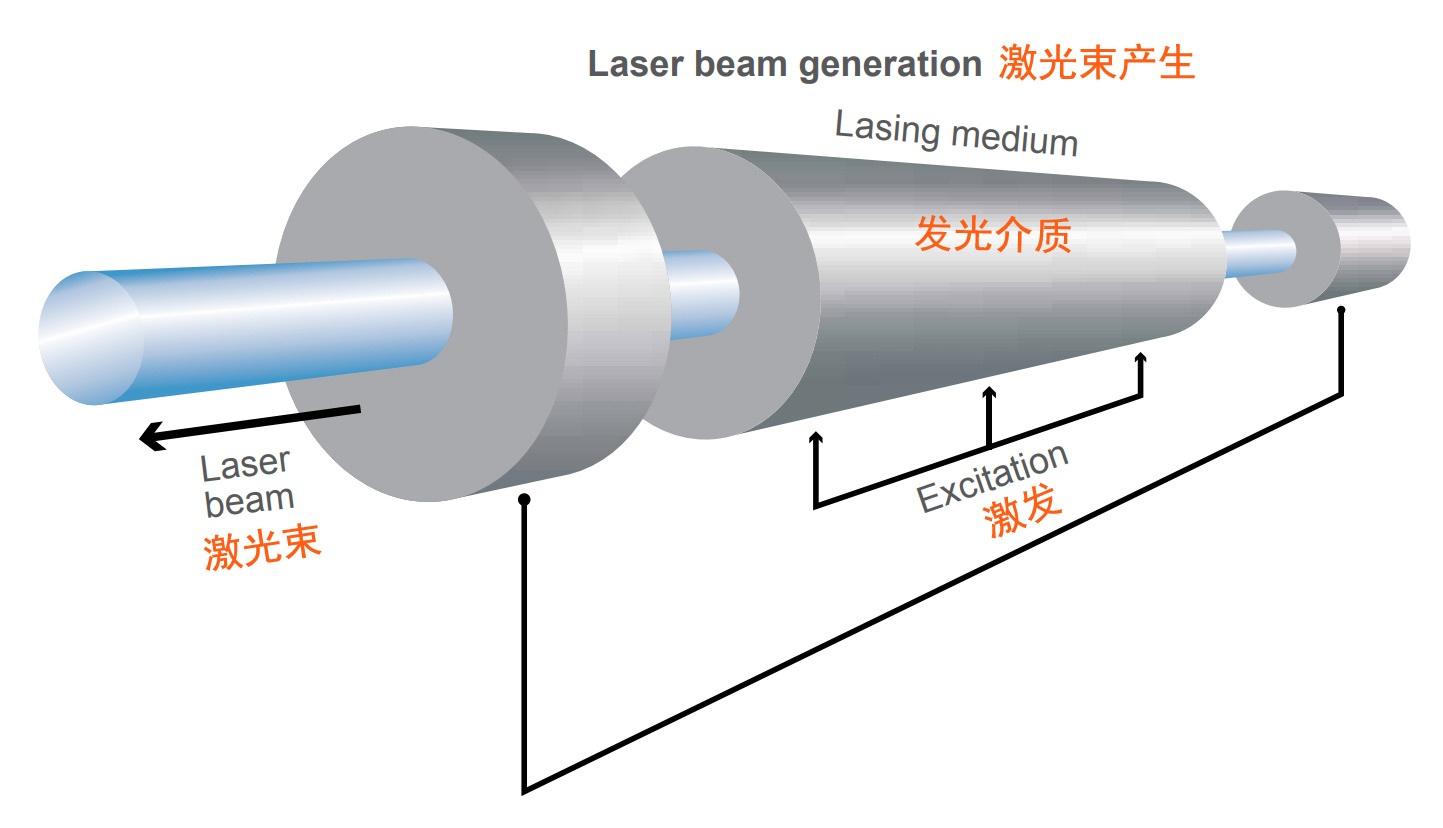
Components of a laser
Laser medium: This can be a gas such as carbon dioxide (CO2), a solid such as neodymium:yttrium aluminum garnet (Nd:YAG), or a liquid such as a dye. One of the properties of the laser medium is that it can store energy in a specific way, known as particle number reversal. The laser medium emits light (photons) as a way to remove excess stored energy.
Excitation mechanism: The way in which energy is applied to excite particles (atoms or molecules) in a laser medium. Energy can be applied in the form of electric current, discharge, light source, etc.
Optical resonator: A system that extracts stored energy from a laser medium in the form of a laser beam. In its simplest form, an optical resonator consists of mirrors located at opposite ends of the laser medium. These mirrors are parallel to each other, so photons traveling along the axes of the two mirrors are constantly reflected back and forth (resonant) between the mirrors. One mirror is 100% reflective and the other partially reflective, so it only transmits some photons that hit it.
Generation of the laser beam
When photons pass through the laser medium, they cause the stimulated particles to release excess energy in the form of other photons, a process known as excitation emission.
These new photons are identical to the original photons that cause stimulated emission. They have the same color (wavelength), travel in the same direction, and are in phase. Photons transmitted by some mirrors form a laser beam. These new photons are identical to the original photons that caused the excitation emission. They have the same color (wavelength), move in the same direction, and are in phase. The photons transmitted by the partial mirrors form a laser beam. The remaining photons are reflected back through the light-emitting medium and continue to stimulate the emission process.
Laser marking process
Laser marking is achieved by removing material from the substrate or changing the surface chemistry of the substrate, and the most important factor is how well the laser beam is absorbed by the material being coded. This can determine the type of laser used, as different wavelengths can have different absorption characteristics. If the laser beam is transmitted or reflected, it becomes more difficult or even impossible to code. To achieve the best results, the focused laser beam must be absorbed a few microns from the surface layer of the material in order to generate sufficient energy density.
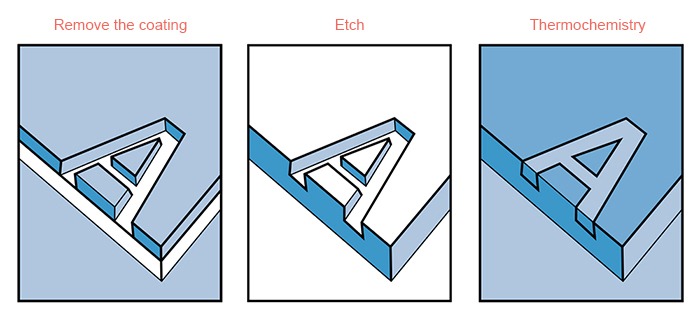
There are three ways to change the surface:
- Removal of coating: The laser is absorbed by the substrate or surface coating, evaporating the coating to reveal a contrasting substrate. An example of this process is the removal of colored ink printed on white paper or cards.
- Etching: The laser evaporates the material from the surface of the substrate without necessarily producing any color change, which is the laser marking process for polymers (PET for beverage bottles). The laser induces thermal stress on the glass, causing micro-cracks in the surface, causing tiny glass crystals to separate from the surface, creating a mark. The marks look similar to embossed printing
- Thermochemistry: Lasers alter materials by heating them to a high enough temperature to break molecular bonds. The new material formed by this process may have different colors, resulting in a recognizable marking.
Types of lasers
Most laser marking systems use one of the following three laser types.
- CO2 uses a mixture of gases excited by an electrical discharge, and the typical infrared output wavelengths of these lasers are 9.3 microns, 10.2 microns, or 10.6 microns.
- Fiber lasers are a special class of solid-state lasers that use optical fibers instead of gas as the luminescent medium. The laser beam is generated and confined to the core of the fiber, which is doped with ytterbium plasma, usually excited by a diode laser. This technical setup produces an emission wavelength band of 1.05 μm to 1.08 μm with its center at 1.06 μm.
- Nd:YAG This is a crystal, usually excited by a flash (strong light source) or diode laser, which produces an infrared laser output with a wavelength of 1.064 microns.
Beam transmission
There are three main types of laser beam delivery systems used to generate markings on the surface of an object.
Mask lasers
First introduced in the early 70s of the 20th century. These systems use a pulsed laser beam, which is designed to have a wide profile. The beam illuminates a thin metal mask through which the desired image or code has been etched. This method can be very fast, as only a short illumination time is required; The disadvantage is that the marking area is relatively small, as it is limited by the laser beam diameter, focusing optics, and power density, in addition, this type of code generation is very inflexible, as it uses a fixed mask that needs to be manually replaced every time the code changes.
Fractional lasers
The term dot matrix for laser marking encompasses different beam transmission principles that generate a pattern of marked dots on a material to form characters or patterns. A beam delivery system is an array of lasers arranged in a vertical arc that sends their beams to the product through a common focusing lens. This array, such as eight lasers, produces a pattern of vertical lines of dots, depending on the laser turned on.
The main disadvantage of mask and lattice beam delivery systems is that the code they generate is static, in contrast to writing a laser beam like a pen on the surface of the product, which is a more general principle of beam delivery. As a result, scribing laser technology is now the most popular technology.
Scribing lasers
These systems are written like a pen, and the first system was based on pulsed Nd:YAG lasers and was introduced in 1969. Systems using continuous-wave (CW) CO2 lasers were not introduced until the early 80s of the 20th century. But in the first few years, this principle was rarely used, because mirrors in each direction required a fast and robust control algorithm, which could only be achieved with a high-performance signal processor.

Lenses are used to focus the laser beam onto a small spot on the surface of the product. Two galvanometer-driven mirrors move the spot on the surface of the product to draw the desired mark or image. The laser beam turns on when coding is needed and turns off when it is not. The rotation of the mirror, driven by the two galvanometers, is controlled by a computer. Computers are typically desktop-based and will accept markup information from a variety of software packages, including word processors, CAD systems, databases, and more.
The scribing laser system is capable of high-quality marking over a large area (up to 600 x 400 mm), using a special flat field lens due to the size of the area to be marked. This is to prevent a decrease in print quality that would otherwise cause the focus to deviate from the optimal position of the surface to be marked as the mark moves away from the centerline of the lens.
Because these systems draw lines only where they are needed, they make very efficient use of the laser beam. This allows the use of low-power (10–20 W) air-cooled CO2 lasers in relatively inexpensive entry-level systems.
With the development of technology, the increase in galvanometer speed, and the reduction in the cost of computing power, scribing laser systems are able to mark highly complex codes onto products at high production speeds.
Grading Criteria and Performance
Many parameters affect a product's coding ability and coding speed.
- Absorption: Exposed metal reflects CO2 lasers and therefore cannot be encoded with CO2 lasers. Absorbent coatings can be marked with a CO2 laser, or they can be marked with a fiber laser.
- Dwell time: defined as the time it takes for a focused laser beam to hit the substrate. Different materials require different energy densities to produce the code. The longer the dwell time required to generate the code, the slower the maximum encoding speed. For example, on recycled cardboard, the printed ink is typically further absorbed to the surface, so the laser needs a longer residence time to remove the ink. Similarly, fast-moving production lines will provide short dwell times for laser marking, so in these conditions, it may be necessary to use high-power lasers or materials that react quickly to lasers.
- Surface treatment: If a surface has a varnish coating, the laser must remove the varnish before the surface can be encoded, which requires a higher energy density.
- The amount of data encoded: With the same laser, the same material, and the same conditions, a complex or large code will take longer to apply than a small code.
- Product spacing: The distance between successive products to be marked. If this distance is less than the marking area of the laser, the time it takes the laser to print each piece of information is reduced.
The safety of the marking machine
No document on lasers is complete without mentioning safety issues. According to the EN 60825-1 standard, lasers used for marking in industrial environments are classified as Class 4 lasers. Therefore, it is essential to incorporate precautions into production facilities to prevent potentially unsafe situations. Using a few simple engineering rules such as guarding, interlocking, etc., similar to those used for other types of machinery, it is relatively easy to get a safe overall system setup.
Performance level
Local industrial regulatory requirements (e.g. Machinery Directive 2006/42/EC) will determine the level of safety required. Today's laser markers can meet the highest 'performance level' 'e' (PLe), which means that the emergency circuit immediately shuts down the laser. For example, if an emergency switch connected to an interlock circuit is turned on, the mark stops immediately. Marking cannot continue until all emergency switches have been turned off and the start button has been pressed. The operation of the latch switch is similar: if it is opened, the mark stops.
Protective measures
Although the laser is not visible, it behaves the same as visible light. The beam is only emitted in a straight line and does not move in a curved path – but directional rays can bypass corners by reflecting surfaces and objects. The laser light reflected from the surface of the product can still contain enough energy to be harmful to the eyesight and skin. Laser light reflected from the surface of the product may still contain enough energy to be harmful to vision and skin. Therefore, a housing should be used to limit the entry of the laser beam, reducing the possible laser radiation from level 4 to level 1 (eye-safe emission). The wavelengths emitted by fiber lasers require a protective shield so that no light is emitted from where the product is marked.
Restricted entry
If areas and rooms containing operating lasers cannot be fitted with direct guards, access must be restricted to only personnel specially trained in laser radiation. These individuals must wear laser safety goggles to protect their eyes from the wavelength of the laser radiation emitted in the area.
Benefits of laser marking:
- The unmodifiable code, the code is etched on the surface of the object, preventing unauthorized removal and helping with anti-counterfeiting.
- High-quality codes, The scribing laser system provides quality codes that match the product brand for high-precision encoding.
- Clean coding, which does not require additional material, only produces the by-products produced during the laser marking process.
- Low cost, no additional consumables required, and only one visual inspection per month, resulting in a lower cost compared to other coding technologies.
- High reliability, since coding is a legal requirement in most industries, the reliability of the equipment is key. The laser marking system is one of the most reliable marking equipment on the market due to its low consumables and high utilization of the laser.
- Non-contact, since there is no physical contact with the surface to be printed, high-speed printing can be achieved.
- Programmability, with the ability to print variable information.
- Complex coding can be realized, and barcodes and QR codes with large amounts of information can be generated.


Be the first to comment