
With the rapid development of science and technology, electronics, medical treatment, biology and materials all need more lightweight, efficient, miniaturized, multi-functional, high-quality laser instruments and equipment. At present, the wavelengths of common lasers are infrared and visible light, and traditional laser tools, processes and technologies have problems such as low efficiency, complex operation, high cost, limited range, serious loss, and low accuracy. In recent decades, ultraviolet lasers have been repeatedly researched and broken by scientists because of their relatively high coherence, more convenient, stable and reliable, low cost, tunable and smaller, high efficiency, high precision and practical use.
Introduction to UV lasers
Ultraviolet lasers are mainly divided into gas ultraviolet lasers and solid-state ultraviolet solid-state lasers. Under the action of the pump source, the working medium reaches the excited state by absorbing the energy of the outside world, and the gain is greater than the loss after the number of particles is reversed, the light is amplified, and the partially amplified optical feedback continues to excite to produce oscillation in the resonator to produce laser. The gas medium mainly uses pulse or electron beam discharge, and excites the gas particles from the low energy level to the high energy level through the collision between electrons, so as to obtain ultraviolet laser. The solid medium is a nonlinear frequency-doubling crystal that produces an ultraviolet laser that radiates outward after one or more frequency conversions. Excimer UV lasers and all-solid-state UV lasers are commonly used in laser processing and processing.
Solid-state Q Nd:YAG lasers
Wavelength: 353 nm; Spot: circular (energy gradually decreasing from center to edge) focusing on the order of 10 μm; It is highly sensitive to temperature, and only reaches stability after a period of cold start, with a high repetition rate and a small focused light spot, making it suitable for small-size processing.
Excimer lasers (gas lasers)
Wavelength: depending on the gas type; Spot: rectangular (mask technology can produce spots with different geometries); Machining details can be as small as a few microns, while the distance between the focusing lens and the workpiece can be as large as 50 to 100 mm.
Metallic steam lasers (mainly using copper steam)
Wavelength: Copper vapor with wavelengths of 511 nm and 578 nm is generated by mixing and doubling ultraviolet light with wavelengths of 255 nm, 271 nm, 289 nm, and the beams are divided into Gaussian distributions; The application range is the same as that of solid-state ultraviolet lasers, and the application range is wide.
Excimer lasers
Gas ultraviolet lasers mainly include excimer lasers, argon ion lasers, nitrogen molecular lasers, fluorine molecular lasers, helium-cadmium lasers, etc., and excimer lasers are usually used for laser processing. An excimer laser is a gas laser with an excimer as the working substance, and it is also a pulsed laser. An excimer is an unstable complex molecule that will break down into atoms under certain circumstances. The repetition rate and average power are used to judge the excimer laser.
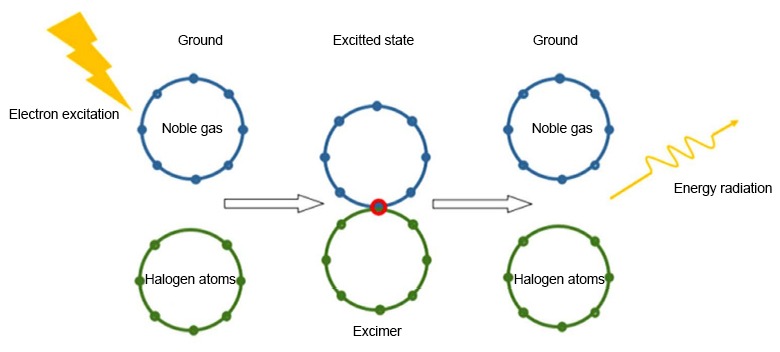
A certain proportion of rare gases such as Ar, Kr, Xe, etc., and halogen elements such as F, Cl, Br, etc., are mixed together with the main working substances of ultraviolet gas lasers, and the method of pumping is achieved by electron beam or pulse discharge. After the noble gas atoms and noble gas atoms in the ground state are excited, the electrons outside the nucleus are excited to a higher orbit to fill the outermost electron shell and combine with other atoms to form an excimer, and then transition back to the ground state and then decompose into the original atoms, and the remaining energy is separated in the form of photons, and finally the ultraviolet laser is obtained by amplification of the resonator.
Liquid xenon is the working substance of early quasi-fraction lasers, and the current excimer lasers also include ArF lasers at 193 nm, KrF lasers at 248 nm, and XeCl lasers at 308 nm.
Solid-state ultraviolet lasers
The outstanding advantages of all-solid-state ultraviolet lasers include convenience, small size, high reliability and stable operation. The most commonly used is the Nd:YAG crystal, which is commonly used for LD pumping, and then doubling the frequency.
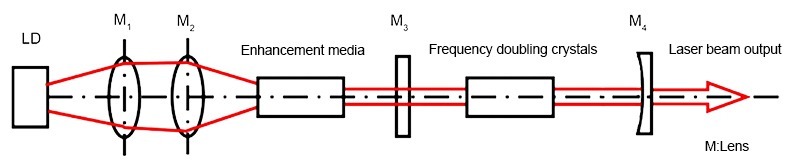
The main step in the generation of ultraviolet solid-state laser is that the pump light source in the laser is irradiated to the enhancement medium to achieve the number of particles reversed, the fundamental red light is formed and oscillated in the resonator, and then the required ultraviolet laser is finally output from the resonator through one or more nonlinear crystal cavity frequency doubling. Ultraviolet solid-state lasers are usually obtained by LD diode pumping and lamp pumping. All-solid-state ultraviolet lasers are LD-pumped ultraviolet solid-state lasers.
Reinforced dielectric crystals
Nd:YAG (neodymium-doped yttrium-aluminum garnet) and Nd:YVO4 (neodymium-doped yttrium-vanadate) are two of the more common reinforcing medium crystals.
The commonly used method of enhancing the resonator is to use a small semiconductor laser diode with a wavelength of 808 nm LD-pumped Nd:YVO4 laser crystal to generate 1064 nm near-infrared light, and the frequency doubling output in the cavity is green light with a wavelength of 532 nm, and then sent into the enhanced resonator for quadruple frequency to output a deep ultraviolet laser with a wavelength of 266 nm, and the input threshold of fundamental green light can be as low as 215 mW.
Compared with Nd:YAG, the Nd:YVO4 laser crystal has a larger gain cross-section, which is 4 times that of Nd:YAG. The absorption coefficient is large, which is 5 times that of Nd:YAG, and has the advantages of low laser threshold. The mechanical strength of Nd:YAG crystal is relatively high, the transmittance of light is high, the fluorescence life is long, and there is no need for a harsh heat dissipation and cooling system, which can be adapted to a wide range of work and use needs, and can obtain high-quality lasers.
Be the first to comment