
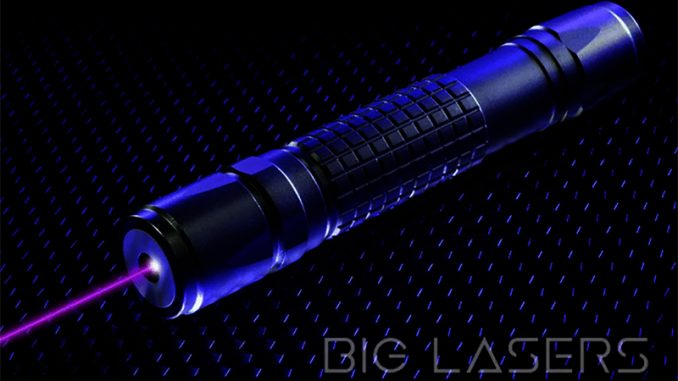
A laser pointer is a small (usually battery-powered) laser device designed to point an object by illuminating it with a collimated, visible laser beam. Most laser pointers, especially inexpensive ones, contain a small GaInP/AlGaInP laser diode that emits light near the red spectral region, a collimating lens, a simple electron diode driver, and a battery compartment, such as three coin cell batteries.
Some of the more expensive indicators, which emit green or even blue or yellow light, often contain a small diode-pumped solid-state laser with a nonlinear crystal for frequency doubling. The green laser pointer is typically based on a miniature Nd:YVO4 laser with a KTP crystal for intracavity frequency doubling. Here, the Nd:YVO4 is beneficial for achieving low threshold pump power, while the KTP operates over a relatively wide temperature range, so there is no need for a temperature stabilization device.
A laser pointer should not be confused with a lamp containing a light-emitting diode (LED), which emits a more dispersed beam (less spatially coherent, similar to an incandescent lamp) and can also emit light of a different color. In contrast, laser dots typically emit quasi-monochromatic light.
Apply
Common laser pointers include red (650-660nm), green (532nm), blue (445-450nm), and blue-violet (405nm). It is usually used by newspapers, teachers, and docents to project a point of light or a ray of light pointing at an object, but it may damage or affect the places where the guide is located, such as art galleries (some paintings are afraid of light), zoos, etc.
Some laser pointers can be used to calibrate mechanical or optical distance measurements.
Brightness and color
The apparent brightness of the illumination point is highly dependent on the wavelength of the emitted light. Most devices work in the red spectral region, and the sensitivity of the eye decreases rapidly as the wavelength increases. Devices with an output wavelength of 650 nanometers appear to be about twice as bright as those emitting the same power at 670 nanometers, and about twice as bright as those at 635 nanometers. However, short-wavelength laser pointers are usually more expensive. This is especially true for green lasers, which are significantly brighter than red lasers. They include diode-pumped solid-state lasers and frequency multipliers, and since frequency multipliers are often less efficient at low power levels, it takes a few hundred milliwatts of infrared light (usually 1064 nanometers) to produce a few milliwatts of green laser, so batteries don't last long unless they're relatively heavy.
The range of the laser pointer
Non-specialists often ask what is the range of laser pointers, to which some manufacturers give some more or less problematic values. If the question means how far the light of the laser pointer can travel, the correct answer is that there is no limit, as long as the light is not absorbed or scattered in the atmosphere. However, due to the divergence of the beam, the beam area will eventually become larger, so the intensity on the screen will decrease even if the overall power remains the same. Therefore, an airplane pilot looking down at such a beam from a height of 10 km will not be disturbed by the remaining small intensity, which can cause big problems at a shorter distance.
The range of the laser pointer can also be understood as the maximum distance at which the light spot can be seen on the screen. This range is usually not limited by beam divergence, but by the overall optical power. Because the problem is not the relatively small divergence from the laser pointer to the screen, but the huge divergence of the scattered light on the way back. As a result, it is easy for a person standing next to an illuminated screen to see the light spots, which are imperceptible from the position of the laser pointers.
Safety hazards
There is a wide debate about laser safety issues associated with laser pointers. Typical output power is a few milliwatts – typically less than 5 mW to comply with safety level 3R, sometimes less than 1 mW to comply with level 2. Direct fixation of a 1 mW beam may irritate the eyes: it can cause temporary flashes of light, blindness. However, usually no one does this for such a long time as to cause serious eye damage. However, if a laser pointer is considered a good toy, then children should be very careful when playing with laser pointers. For example, if someone walks down a staircase or a car driver is stimulated by a laser beam, there is a serious danger.
There are reports that cheap green laser pointers for sale do not have a filter to eliminate infrared light, so they can emit hundreds of milliwatts of light in the infrared spectral region. This is obviously a terrible security hazard; A direct hit to the eye by this beam can permanently damage the eye in a fraction of a second.
For calibration
In principle, laser pointers can be used for calibration purposes. However, there are some special alignment lasers that may be more suitable for this application. For example, their housings can be more convenient to install, and the beam direction may be more stable.
Be the first to comment