
The simplest type of wave is a monochromatic plane wave, described by the following complex wave amplitude, as a function of spatial position x and time t:

With a wave vector, its amplitude is the wave number k and the angular frequency ω. The wavenumber determines the wavelength and is defined as the spatial period of the wave (e.g., the distance between the maxima of subsequent oscillations, see Figure 1):


(Note that in spectroscopy, wavenumber is often considered the reciprocal of wavelength and does not involve factor 2 π.) )When propagating a wavelength in the x-direction, the plane wave acquires a phase delay of 2π. Wavelength and frequency are correlated with each other: when a wave travels one wavelength in an oscillation period, its phase velocity c is given by the following formula:

For wave packets, there is another velocity called group velocity, and if there is dispersion, then it can deviate from the phase velocity, i.e., the dependence of the phase velocity on frequency.Note that for waves with different spatial distributions, e.g., for strongly focused laser beams, the amplitude is a function of position and is generally not (or incompletely) periodic, the spacing between the maxima of subsequent waves may differ from the wavelength, it is always defined as a plane wave, which is essentially the deviation of the Gaussian beam from the plane wave.
Wavelength and color
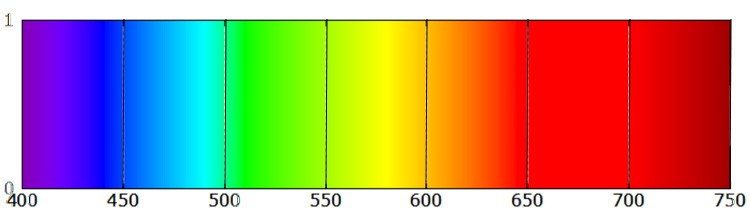
Monochromatic light possesses a certain color based on its wavelength. Unfortunately, computer screens do not produce monochromatic light and can only be represented in visual colors that approximate certain wavelengths. This has been shown in Figure 1 in color, and it will appear different on different computer screens.
Vacuum wavelength and wavelength in medium
If a monochromatic light wave propagates with a different transparent medium, its wavelength changes, while its optical frequency ν remains the same. Therefore, it is most natural to use its light frequency to represent this light wave. However, due to history, the wavelength in the air is most commonly used to represent light waves (light) (for standard pressure and temperature: 1013.25 mbar, 15°C, zero humidity). However, in some cases, the vacuum wavelength is specified. Because the wavelength in the air is very close to the wavelength of the vacuum, the refractive index of the air is only slightly above 1, a small difference that is not relevant to most applications, and a vacuum wavelength of 1000 nm corresponds to 999.7259 nm in the air.
Wavelength calculations
For a given vacuum wavelength λ0, the wavelength in a medium with a refractive index n is λ = λ0/n. Typically, the refractive index depends on the frequency of light or the wavelength of the vacuum (→ dispersion).
For visible light, the vacuum wavelength is approximately between 400 nanometers and 700 nanometers, the visible spectral region is not precisely defined, and the sensitivity of the human eye is a smooth function of wavelength and varies from person to person. The light with a longer wavelength in a vacuum is called infrared light, while the light with a shorter wavelength is called ultraviolet light.
If some physical quantity depends on the optical frequency, then it is often referred to as wavelength dependent rather than frequency dependent, even though the spatial aspect does not play a role in the phenomenal correlation.
In addition, the optical bandwidth is often specified by the width of the wavelength range rather than the frequency range (e.g., the laser gain medium with the gain bandwidth). For the conversion between wavelength and frequency range, it is only necessary to remember that the width of the frequency interval depends not only on the width of the corresponding wavelength interval, but also on the average wavelength: δν = (c / λ2) δλ (assuming the interval is small).
Measurement of the wavelength of light
The wavelength of light can be measured with a wavelength meter, which is an interferometer. The wavelength is evaluated indirectly and much more accurately based on the measured light frequency and the vacuum speed of light, because the light frequency can be measured with high accuracy, whereas now (in the SI system) the vacuum speed of light is a defined quantity (i.e. without any measurement error).
Wavelength standards
It is common to use some spectral lamp as a precise wavelength standard. In addition, there are optical frequency standards that rely on more complex techniques, where more wavelengths are obtained than are orders of magnitude precise.
Non-monochromatic light
- In many cases, light is not monochromatic but exhibits a considerable optical bandwidth. In general, the peak wavelength or average wavelength is determined based on the "center of gravity" of the optical spectrum.
- In some cases, one needs to know how the optical power is distributed over different wavelengths or frequencies. This can be done with an optical spectrum analyzer, preferably by providing a precisely defined power spectral density (PSD) as a function of wavelength or frequency, e.g. in W/nm or W/THz.
The importance of wavelengths of light
The wavelength of light is associated with many phenomena
- The longer the wavelength of light, the stronger its diffraction tendency, that is, the expansion of the beam (e.g. a laser beam). Due to the very short wavelength of light, the diffraction-limited beam emitted by many lasers can exhibit a fairly small beam divergence, allowing it to propagate over considerable distances without a significant increase in beam area. Wavelength is also important with other diffraction phenomena, such as in diffraction gratings.
- Wavelength is the fundamental quantity of any interference phenomenon. Due to the relatively short wavelengths of light, optical interferometers require extremely stable machinery, and even a slight change in the propagation length in the sub-micron range can affect the interference conditions.
- Many optical nonlinearities only have a substantial impact when phase matching is achieved. The phase matching condition includes the wavelength of the beam of interest, not just the frequency of the light.
Among other influences, the amount that is actually uncorrelated is the frequency of light, which of course is wavelength-dependent. For example, the resonance effect of laser active ion light pumping produces a strong frequency dependence. The wavelength itself is larger than that of atoms or ions, and of course has nothing to do with these.
Special types of wavelengths
- In optics and photonics, there are many different terms that refer to the word "wavelength".
- The emission wavelength of a light source is the wavelength of the vacuum (or wavelength in the air) of the emitted light.
- The Bragg mirror at the Bragg wavelength is the highest reflectivity of the mirror at the vacuum wavelength.
- The waveguide with a cut-off wavelength is a vacuum wavelength, and the guide mode above it stops existing.
- This zero dispersion wavelength is a vacuum wavelength in which the group velocity dispersion normally optical fibers disappear.
- Wavelength tuning means modifying the laser's emission wavelength (optical frequency).
- Wavelength division multiplexing is a multiplexing technology that works in the time domain and is often used in optical fiber communication.
Be the first to comment