
Passive Q-switching consists of optical elements, such as those filled with organic dyes or doped crystals, with transmissive properties: the material becomes transparent as the energy density increases. When the density reaches a certain high value, the material is "saturated" or "bleached", resulting in a high transmittance. The bleaching process in saturable absorbers is based on the saturation of the spectral transition.
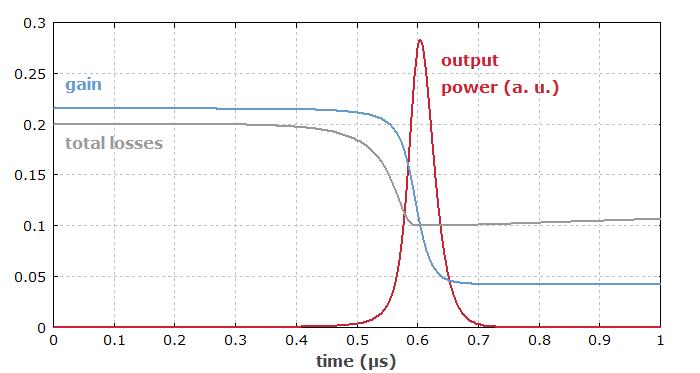
Shortly after the laser gain exceeds the resonator loss, a short pulse is emitted. Once the absorber begins to saturate, the power rises rapidly until the gain is saturated to the level of resonator loss.
If this material, which has a high absorption of laser wavelengths, is placed inside a laser resonator, it initially prevents the laser from oscillating. As the gain increases during the pump pulse and exceeds the round-trip loss, the luminous pull-up in the cavity increases dramatically, resulting in the saturation of the passive Q switch. Under these conditions, the losses are very low, and Q-switched pulses are established.
Since passive Q-switching is switched by the laser radiation itself, there is no need for high-voltage, fast electro-optical drivers or RF modulators. Passive Q-modulation is an alternative to the active method, which has the advantage of being particularly simple in design. As a result, the system is small, very robust and costly. The main disadvantage is that the accuracy of the external control performance is not high, and its output energy is lower than that of electro-optical or acousto-optic Q-switched lasers, which is that the residual absorption of saturable passive Q-switched lasers causes very large losses.
Be the first to comment