
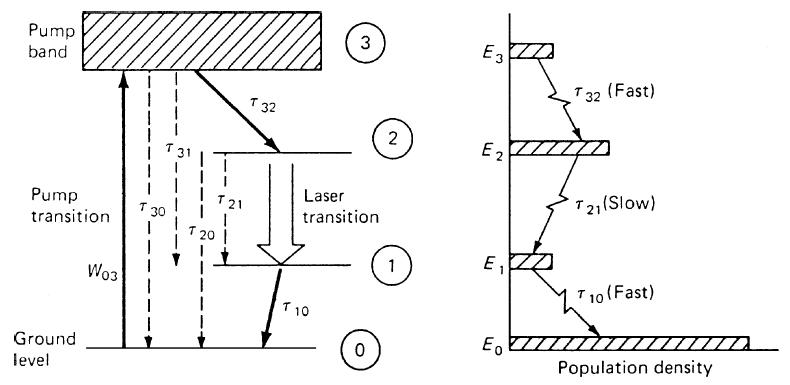
The figure above shows a four-level laser system unique to rare earth ions in glass or crystalline matrix materials. It is important to note that the characteristics of the three-level laser material are as follows: the laser transition occurs between the stimulated energy level 2 and the final ground state 1 (the lowest energy level of the system), which leads to inefficient operation.
The four-level system avoids this drawback, and the pump transition extends from the ground state (now energy level E0) to a wide absorption band E3. As in the case of three-level systems, the excited ions will quickly enter the metastable energy level E2. However, in a four-level system, the laser transition occurs between the E2 level and the fourth terminal level, E1, located above the ground state E0, where the ions undergo a rapid non-radiative transition to the base level.
In a true four-level system, the terminal energy level E1 is empty, and as a qualified four-level system, the relaxation time between the terminal laser energy level and the base energy level of the material must be significantly shorter than the fluorescence lifetime, i.e., τ10<<τ21. In addition, the terminal laser energy level must be well above the base energy level, so that the number of hot particles can be reduced.
In some laser materials, the energy difference between the lower energy levels and the ground state is relatively small, therefore, they must be cooled before they can be used in four-level lasers. In a four-level system, even if the pump power is close to 0, there is a reversal of the 2→1 transition, and it is no longer necessary to provide the high pump rate required to maintain the balance of the three-level system. Under the most favorable conditions, the relaxation time of the 3→2 and 1→0 transitions in the four-level system is shorter than the spontaneous radiation lifetime of the laser transition τ21. Therefore, it is still possible to calculate according to the method that only the energy states E1 and E2 have the number of particles.
Difference Between Three-Level and Four-Energy Level
The efficiency of three-level lasers is not high because almost all particles are in the ground state before pumping, and the particle number reversal can only be achieved if the pump source is strong and the pumping is fast.
The four-level system is to make the system realize the inversion of the number of particles between the two excited states E2 and E1. Because the low energy level E1 is not the ground state but the excited state, the number of particles on it is very small, so as long as the number of particles on the metastable state E2 accumulates slightly, it is easy to realize the inverted distribution of the particle number and generate a laser between the energy levels E2 and E1. Because the number of particles on E3 transitions to E2 and the number of particles on E1 transitions to E0, the whole process is easy to form a continuous reversal, so the efficiency of the four-level system is higher than that of the three-level system.
Abstract generalizations
Regardless of whether it is a three-level system or a four-level system, the laser marking machine must have a metastable state inside and an excitation source (pump) outside to realize the inversion of the number of particles, and the whole transport process of particles must be a cyclical non-equilibrium process. The role of the activating medium is to provide metastability. The so-called three- or four-level diagrams are not actual energy level diagrams of the activation medium, they are only abstract generalizations of the entire physical process that causes the inverted distribution. The actual energy level diagram is more complex than this, and there may be several inverted distributions between the inverted energy levels within an activation medium, emitting several wavelengths of laser light accordingly.
Be the first to comment