
High-power lasers are the most susceptible to generating heat from the laser gain medium, which can cause a number of disadvantages, including thermal fracture and thermal lensing. The usual solution: minimize use or effectively remove waste heat. This was invented by Steven R. Bowman of the Naval Research Laboratory in Washington, D.C.
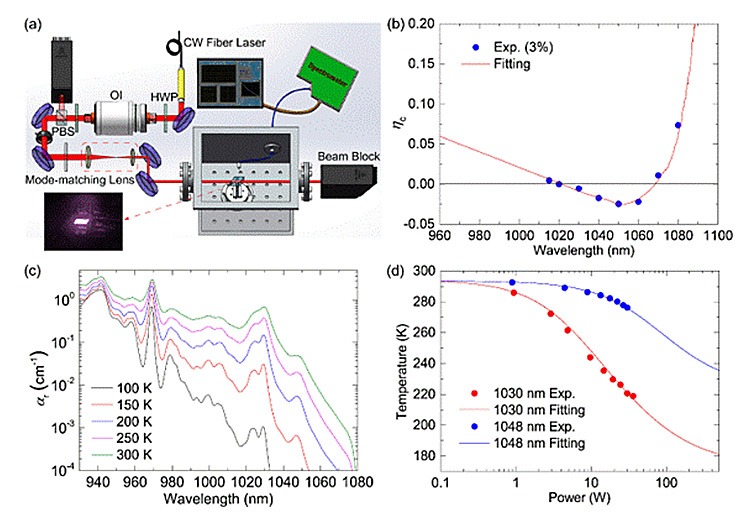
Replacement concept for radiation-balanced lasers (or heatless lasers): counteracting thermal problems by eliminating the thermal load, which can be achieved using the principle of optical cooling. If certain conditions are met, fluorescence cooling can fully compensate for the heat in the laser emission. The pump of this photon energy must be higher than the laser radiation (normal), but also lower than the average fluorescent photon energy (which is extraordinary).
Entropy considerations
The laser consideration of entropy is very interesting. The conversion of pump light to laser is associated with a decrease in entropy, mainly due to the fact that light is collected from many modes and concentrated in a few modes of the radiated field. In conventional lasers, the entropy associated with heat dissipation not only compensates for this, but in radiation-balanced lasers, the latter mechanism does not exist. But fluorescence produces enough entropy to avoid violating the second law of thermodynamics, which requires that the total number of entropy cannot be reduced.
Current status quo and prospects
Current status of this research: The concept of a radiation-balanced laser has been theoretically studied in some detail [1, 3] (using thermodynamic principles), suitable materials have been studied (mainly ytterbium-doped gain media) [2]], and lasers with reduced (but not yet fully compensated) internal heating have been demonstrated [4], but radiation-balanced lasers have not yet been fully demonstrated.
Problems with radiation lasers
Difficulties in introduction:
Unfortunately, the concept of radiation-balanced lasers introduces a number of limitations that make the implementation of practical high-power radiation-balanced lasers difficult. First of all, because the gain medium must have a suitable absorption and emission spectrum and must exhibit low parasitic heating (high quantum efficiency, less parasitic absorption). And it is necessary to choose the appropriate pump and laser wavelength for the local area, and in addition, under various trade-offs, this form is not available in traditional lasers.
Low laser power efficiency:
Because these trade-offs limit the achievable benefits and (more importantly) the power efficiency of the laser: the cooling mechanism requires a lot of fluorescence, which also takes away a lot of power, so the maximum achievable efficiency will not exceed 30% in most of the configurations considered, while some traditional high-power lasers, such as thin-disk lasers and fiber lasers, will be more efficient. So the scale-out of the gain medium (and therefore the achievable output power) is limited by the requirement to avoid excessive reabsorption of fluorescence, which can interfere with the cooling process.
Concept Advantages:
So, although the practical relevance of the concept is quite limited, the concept is theoretically very interesting, and dealing with it can improve the understanding of the thermodynamic aspects of lasers as well as the various limitations. Finding the right gain medium also brings many benefits to optical cooling in other situations.
Be the first to comment