
Laser (rarely written as l.a.s.e.r.) is an acronym for "Light Amplification by Stimulated Emission of Radiation", coined in 1957 by laser pioneer Gordon Gould. While this original meaning denoted a principle of operation (the use of stimulated emission of excited atoms or ions), the term is now mainly used primarily in devices that produce light based on the principle of lasers. More specifically, it usually refers to a laser oscillator, but sometimes it also includes a device with a laser amplifier called a master oscillator power amplifier (MOPA). A broader interpretation includes nonlinear devices such as optical parametric oscillators and Raman lasers, which also produce laser-like beams and are usually pumped with lasers, but are not lasers per se strictly speaking.
Laser technology is central to the broader field of photonics, mainly because lasers have some very specific properties:
- Lasers are typically emitted as well-directed laser beams that can propagate over long distances without much divergence (usually limited by diffraction only) due to their high spatial coherence, and can be focused to very small spots of light, resulting in high intensity.
- It usually has a very narrow optical bandwidth (high temporal coherence), whereas the light emitted by most lamps, for example, has a very broad spectrum. However, there are also broadband lasers, especially ultrafast lasers (lasers with pulse widths in the picosecond order and less).
- Lasers can be emitted continuously, or in short or ultrashort pulses, with pulse durations ranging from microseconds to femtoseconds. The concentration of pulse energy in time, the high focus of the beam, can produce higher intensity energy.
These properties make lasers very meaningful in a range of applications, in large part as a result of the high temporal and spatial coherence of laser radiation.
In laser technology, optical components such as laser crystals, laser mirrors, polarizers, Faraday isolators, and tunable filters are widely used; See our article on laser optics.
How lasers work
Basic principle
A laser oscillator typically consists of an optical resonator (laser resonator, laser cavity) in which light can be cycled (e.g., between two mirrors), and a gain medium (e.g., laser crystal) within this resonator for light amplification.
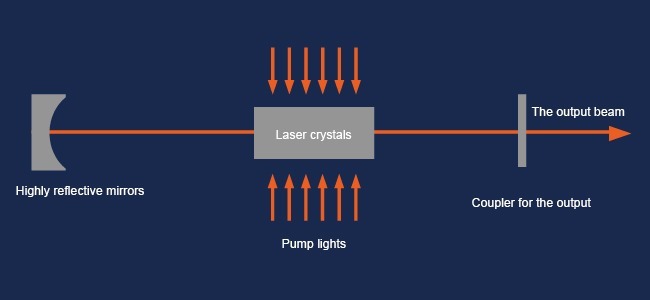
Without a gain medium, the circulating light becomes weaker and weaker with each resonator round trip because it has many losses, such as the reflection of light on a mirror. However, if the gain is high enough, the gain medium can amplify the circulating light, thus compensating for the loss. The gain medium requires some external energy supply – it needs to be "pumped", for example by injecting light (optical pumping) or electric current (electric pumping→ semiconductor lasers), and laser amplification is based on the principle of stimulated emission.
A simple optically pumped solid-state laser device, the laser resonator consists of a highly reflective curved mirror and a partially transmitted plane mirror, the output coupler, which extracts some of the circulating laser light as useful output. The gain medium is a laser crystal or laser bar, which is side-pumped, for example with light from a laser diode or flash lamp.
If the gain is less than the loss of the resonator, the laser will not work; At this point, the device is below the so-called laser threshold and can only emit some faint cold light. Only when the pump power is above the laser threshold will there be a significant power output, at which point the gain can reach (or temporarily exceed) the level of resonator loss.
If the gain is greater than the loss, the optical power in the laser resonator rises very quickly, e.g. starting with low levels of light from fluorescence. Note that the resonator round-trip time is typically very small (e.g. a few nanoseconds, or even less for compact lasers), so even a small net round-trip gain means that the power in the cavity increases exponentially quickly.
Since the high laser power saturates the gain by extracting energy from the gain medium, the laser power will reach a level at steady state such that the saturation gain is just equal to the loss of the resonator (gain clamping). Before reaching this steady state, the laser usually undergoes relaxation oscillations (which is only one aspect of laser dynamics). The threshold pump power is the pump power when the small signal gain is just enough to produce a laser.
A portion of the optical power circulating in a resonator is usually transmitted by a partially transparent mirror, the so-called output coupler mirror. The resulting beam constitutes the useful output of the laser. The transmission of the output coupling mirror can be optimized to achieve maximum output power (see also: Slope Efficiency). In most cases, there is only one output coupler.
Spatial coherence of laser radiation
A high degree of spatial coherence of laser radiation can be achieved, mainly because the emission of light is triggered (excited) by the intracavity radiation (i.e., the light circulating in the laser resonator) itself, rather than occurring spontaneously in an incongruous manner. As mentioned above, spatial coherence is the physical basis for the feasibility of forming a directional laser beam with low divergence and focusing light into very small spots.
Temporal coherence
Temporal coherence is a different issue, and its origins are completely different. Some laser gain media can only emit light in a narrow spectral range. However, even if this is not the case, lasers tend to emit light at only one precisely defined wavelength or frequency (especially in CW operation) because the condition is that only that wavelength has a net round-trip gain of zero and the other wavelengths have a negative net round-trip gain. For example, by using an tunable cavity bandpass filter (Lyot filter), the laser is tuned to the precise desired wavelength (in the emission region of the gain medium).
In extreme cases, the linewidth of the laser can be limited to values below 1 Hz (using some laser stabilization methods). This is many orders of magnitude lower than the average frequency (hundreds of terahertz). Optical clocks involve this highly stable laser.
Even ultrashort pulses can exhibit very high temporal coherence, in this case involving coherence between subsequent pulses in a regular pulse train. This is related to the formation of the frequency comb that acts as a spectrum. While the spectrum can be very wide overall, each comb line can be very narrow and has a well-defined frequency.
Generation of light pulses
Some lasers operate in a continuous manner, while others produce particularly strong pulses. There are a variety of (very different) methods of generating pulses with lasers, allowing the generation of pulses lasting microseconds, nanoseconds, picoseconds, or even femtoseconds (ultrashort pulses from mode-locked lasers), and typically, the laser medium can accumulate a certain amount of energy in some "pump" time in order to release it in a shorter time.
When only a single resonant mode can oscillate, the optical bandwidth (or linewidth) of a continuously operating laser can be very small (single-frequency laser). In other cases, especially for mode-locked lasers, the bandwidth can be very large – in extreme cases, it can span the full octave. The center frequency of laser radiation is usually around the frequency of the maximum gain, but if the loss of the resonator is frequency-dependent, then the laser wavelength can be adjusted within the range of sufficient gain. Some broadband gain media, such as Ti:sapphire and Cr:ZnSe, allow wavelength tuning in the hundreds of nanometer range.
Laser type
Laser technology is a fairly diverse field that utilizes a variety of different types of laser gain media, optics, and technologies. Common types of lasers are:
- Semiconductor lasers (mainly laser diodes), electrically (or sometimes optically) pumped, efficiently produce very high output power (but often poor beam quality), or low power with good spatial characteristics (e.g. for CD and DVD players), or pulses (e.g. for telecommunications applications) with very high pulse repetition rates. Special types include quantum cascade lasers (for mid-infrared light) and surface-emitting semiconductor lasers (VCSELs, VECSELs, and PCSELs). Some of them are also suitable for generating high-power pulses.
- Ion-doped crystal- or glass-based solid-state lasers (doped insulator lasers), pumped with a discharge lamp or laser diode, to produce a high output power, or a lower power with very high beam quality, spectral purity, and/or stability (e.g. for measurement purposes), or ultrashort pulses with picosecond or femtosecond durations. Common gain media are Nd:YAG, Nd:YVO4, Nd:YLF, Nd:glass, Yb:YAG, Yb:glass, Ti:sapphire, Cr:YAG, and Cr:LiSAF. A special type of ion-doped glass laser is.
- Fiber lasers, based on optical glass fibers, are doped with some laser-active ions in the fiber core. Fiber lasers can achieve extremely high output power (up to kilowatts), have high beam quality, have wide wavelength tunable operation, narrow linewidth operation, etc.
- Gas lasers (such as helium-neon lasers, carbon dioxide lasers, argon-ion lasers, and excimer lasers), which are gas-based, are typically excited with a discharge. Frequently used gases include CO2, argon, krypton, and gas mixtures such as helium-neon. Common excimers are ArF, KrF, XeF, and F2. Such lasers are also known as molecular lasers in terms of the gas molecules involved in the laser process.
Less common are chemical and nuclear pumped lasers, free electron lasers, and X-ray lasers.
Laser sources in a broad sense
There are some light sources that are not lasers in the strict sense of the word, but are often referred to as laser sources:
- In some cases, the term is used to amplify emitting devices (excluding seed amplifiers) without input. An example is an X-ray laser, which is usually a source of superradiation, based on spontaneous emission, followed by single-pass amplification. Then there is no laser resonator.
- A similar situation occurs with optical parameter generators, however, the amplification here is not based on excitation emission, but on the parametric amplification of optical nonlinearity.
- Raman lasers utilize amplification based on stimulated Raman scattering.
Light from such devices can have laser-like properties, such as strong directed emission, high spatial and temporal coherence, and narrow optical bandwidths.
In other cases, the term laser source is justified because the source contains lasers as well as other components. For combinations of lasers and amplifiers (main oscillator power amplifiers), as well as sources based on nonlinear frequency conversion of laser radiation, e.g. with frequency multipliers or optical parametric oscillators.
Laser applications
A wide range of different laser machines have a very wide range of applications. They are mainly based on various special properties of lasers, many of which are not achievable with any other type of light source. Particularly important areas of application are laser material processing, optical data transmission and storage, and optical metrology.
Still, so far, many potential laser applications have not been able to be realistically realized because lasers are relatively expensive to manufacture – or more accurately, because they are currently mostly manufactured using relatively expensive methods. Most lasers are manufactured in a relatively small size and have limited automation. On the other hand, lasers are relatively sensitive in all aspects, such as in terms of precise alignment of optical components, mechanical vibrations, and dust particles. As a result, research and development is underway to find more cost-effective and robust solutions.
For commercial success, it is often critical to develop not only high-performance, low-cost lasers, but also to identify the most suitable applications, or to develop the most suitable lasers for a particular application. In addition, it is very important to know the details of the application. For example, in laser material processing, knowing the exact requirements for laser wavelength, beam quality, pulse energy, pulse duration, etc., is essential to achieve the best processing results.
Be the first to comment