
A laser oscillator is essentially a combination of two basic components: an optical amplifier and an optical resonator.
Optical resonator
The optical resonator consists of two relatively parallel plane mirrors or curved mirrors perpendicular to the optical axis of the active material, which play the role of a highly selective feedback device, coupling part of the signal emitted by the amplification medium to feedback, and its phase remains unchanged, thus producing optical oscillation.
The diagram below illustrates the basic elements of a laser oscillator, where a pump lamp inverts the number of particles in the laser material and stores energy at the upper laser energy level. If this energy is released into the beam through stimulated radiation, light amplification is produced.
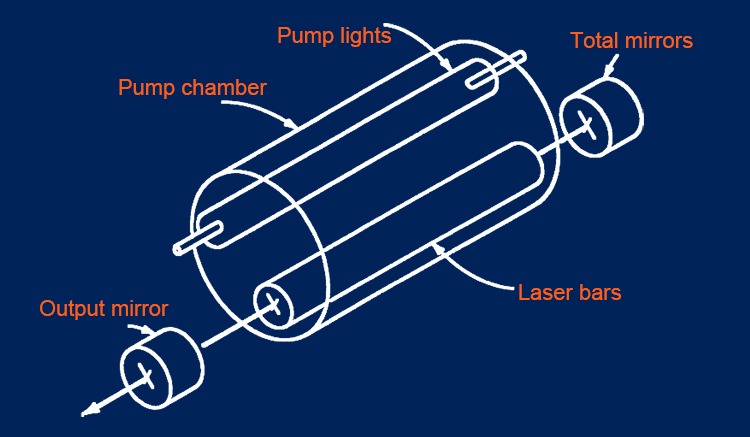
After the system is excited by spontaneous radiation emitted along the axis of the laser, the system will begin to oscillate if the feedback is large enough to compensate for the internal losses of the system. The magnitude of the feedback depends on the reflectivity of the mirror, and decreasing the reflectivity of the mirror is equivalent to decreasing the feedback coefficient. The output mirror of the optical apparatus must be partially transparent to allow some of the radiation to escape or emit out of the oscillator.
An optical device consisting of two parallel plane mirrors is called a Fabry-Perot resonator (also known as an F-P cavity). The role of the resonator is to maintain the electromagnetic field distribution, the loss of which is compensated by the amplified medium by stimulated radiation. Thus, the resonator determines the spectral, directional, and spatial properties of the laser radiation, while the amplification medium acts as the energy source.
Optical amplifiers
The arrangement of the flash lamp and laser bar shown in Figure 3.1 is referred to as side-pumping or laterally pumping, because the pump radiation hits the laser bar from the side relative to the direction of laser radiation propagation. Water or any other suitable coolant is pumped through the annular space between the lamp housing and the inner diameter of the flow tube. The cross-section of the pump chamber can be oval or tightly wound around the lamp and laser bar, and the latter design of the pump chamber is called close coupling.
Instead of the flash as shown, a laser diode array can be placed along the length of the laser bar. Since the radiation output of the laser diode is directional, there is no need for a reflective pump chamber like that of a flash lamp. However, in some cases, focused optics are inserted between the laser diode and the laser crystal to shape or concentrate the pump beam.
Since the output of the laser diode can be collimated and focused, the pump radiation can also be introduced through the post-reflector shown in the figure above, as opposed to the radiation from the flash lamp. In this so-called end-pumping or longitudinal pumping scheme, the pump radiation and the laser radiation propagate in the same direction.
Pump chamber
The structure of the two mirrors used to reflect laser radiation is often described as a laser resonator, however, it is sometimes referred to as a cavity or laser cavity. This is in contrast to the pump chamber, which is the enclosure used to contain the flash radiation. A pumphead is a structural and mechanical component that contains a laser crystal, a pump source, a cooling channel, and an electrical connection.
Be the first to comment