
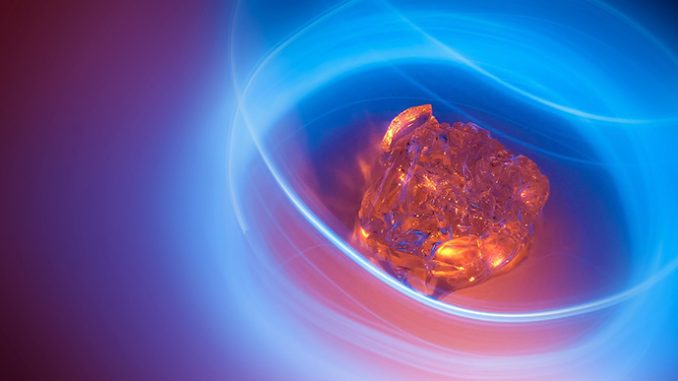
- A laser crystal is an optical crystal - usually a single crystal (a single crystal optical material) that is used as a gain medium for solid-state lasers. In the vast majority of cases, they are doped with trivalent rare earth ions or transition metal ions. When absorption-pumped light (photo-pumped) energy is supplied to crystals, these ions cause these crystals to be stimulated to amplify the light at laser wavelengths.
- Compared to doped glass, crystals typically have a high transition cross-section, smaller absorption and emission bandwidths, higher thermal conductivity, and possible birefringence (these differences are discussed in more detail in the article on laser glass). In certain cases, single-crystal laser materials may be replaced by ceramic laser gain media, which will have finer polycrystalline structures.
The most commonly used laser active rare earth ions and main media and the representative emission wavelengths are shown in the table below:
| ION | Common host crystals | Important emission wavelengths |
|---|---|---|
| Nd3+ | Y3Al5O12(YAG)、YAlO3(YALO)、YVO4(Yttrium vanadate)、YLiF4(YLF)、tungstate(KGd(WO4)2、KY(WO4)2) | 1064、1047、1053、1342、946nm |
| Yb3+ | YAG、tungstate(KGW、KYW、KLuW)、YVO4、Borate(BOYS、GdCOB)、Apatite(SYS)、Sesquioxide(Y2O3、ScO3) | 1030,1020–1070nm |
| Er3+ | YAG、YLF | 2.9,1.6 µm |
| Tm3+ | YAG | 1.9–2.1 µm |
| Ho3+ | YAG | 2.1,2.94 µm |
| Ce3+) | YLF、LiCAF、LiLuF、LiSAF and similar fluorides | 0.28–0.33μm |
The following table lists common transition metal doped crystals: Table 1: Common rare earth ions in laser-active crystals.
| ION | Common host crystals | Important emission wavelengths |
|---|---|---|
| Ti3+ | sapphire | 650–1100nm |
| (II)(Cr2+) | Zinc chalcogenides,ZnS、ZnSe、Zn xSe1-x | 2–3.4µm |
| (III)(Cr3+) | Al2O3(Ruby)、LiSrAlF6(LiSAF)、LiCaAlF6(LiCAF)、LiSrGaF6(LiSGAF) | 0.8–0.9µm |
| (IV)Cr4+) | YAG,MgSiO 4(Forsterite) | 1.35–1.65μm(YAG),1.1–1.37μ(Forsterite) |
Table 2: Common transition metal ions in laser-active crystals.
These tables contain only the most common main crystals; Of course, there are other crystals, but they are used less frequently.
Important advantages of the main crystal
The host crystal is not only a means of immobilizing laser active ions in certain spatial locations, but also the host material has many properties that are important:
- The medium will have high transparency (low absorption and scattering) in the wavelength range of pump and laser radiation, as well as good optical homogeneity. This depends to some extent on the quality of the material and is determined by the details of the manufacturing process.
- The host medium strongly influences the wavelength, bandwidth, and transition cross-section of the pump and laser transitions, as well as the upper-energy lifetime. For example, compared to Nd:YAG,Nd:YVO4 has a higher cross-section, more gain bandwidth, and a smaller up-level lifetime。Other neodymium matrices provide transition wavelengths, such as 1047 or 1053 nm from Nd:YLF.
- Non-radiative transitions, such as multiphonon transitions, can also be strongly influenced by the host, especially by maximal phonon energy. Some of these transitions are very detrimental and cause the number of particles in the upper energy state to quench (thus reducing the quantum efficiency). Others are essential for laser manipulation, such as the removal of ions from lower laser levels. The energy transfer process also depends on the host material.
- The maximum possible doping concentration depends largely on the host material and its manufacturing method.
- Different crystalline materials vary greatly in hardness and other properties, which determines which method they can use and how easily they can be cut and polished with good quality.
- Some materials are chemically unstable, such as hygroscopic.
- Especially for high-power lasers, which are usually sufficient for low to medium power, tolerance to high thermal conductivity, low thermo-optical coefficient (for weak thermal lenses), and high mechanical stress is ideal.
- Optical isotropy may be beneficial, but in other cases, birefringence (reducing thermal depolarization) and gains that may depend on polarization are better (see also: Polarization of Light).
- A high damage threshold in terms of pulse energy density or peak intensity is important for high-energy amplifiers.
Obviously, different applications result in very different requirements for the laser gain medium. For this reason, a wide range of different crystals are used to make the best performance for building the laser.
Ordinary crystalline laser host medium
Crystalline media have a wide range and can be grouped according to important atomic components and crystal structures. Some of the important crystal groups are:
- Garnets, such as Y3Al5O12 (YAG), Gd3Ga5O12 (GGG), and Gd3Sc2Al3O12 (GSGG): hard and chemically inert materials, optically heterogeneous, with high thermal conductivity;
- Sapphire (Al2O3) (e.g. for titanium-sapphire lasers) and aluminate, for neodymium-doped YAlO3 (YALO, YAP): high hardness and thermal conductivity, anisotropic;
- Y2O3, Sc2O3 isosesquioxides: isotropic, high hardness, good thermal conductivity;
- vanadates, such as YVO4 and GdVO4: very high laser cross-section of Nd3+, anisotropic;
- Fluoride, such as YLiF4 (YLF): good UV transparency, birefringence, high energy storage capacity of Nd:YLF; LiCAF, LiLuF, and LiSAF were also used as chromium-doped broadband gain media;
- Silicates such as MgSiO4 (forsterite): wide gain bandwidth;
- Monoclinic ditungstatetes, such as KGd(WO4)2 (KGW) and KY(WO4)2(KYW): combine a relatively high Yb3+ laser cross-section, a large gain bandwidth, and high thermal conductivity
- Disordered tetragonal bitungstatetes, such as NaGd(WO4)2 (NGW) and NaY(WO4)2 (NYW): the ytterbium gain bandwidth is particularly large;
- Chalcogenides, such as ZnS or ZnSe for mid-infrared lasers.
Laser crystals with integrated saturable absorbers
Some of the laser crystal materials have been confirmed, and the saturable absorber materials in them are used in passive Qa-switched lasers. For example, Cr4+ ions can be bound to such Nd-doped crystals for emission in the 1-μm spectral region. And this has been tried with Cr:Nd:YAG and Cr:Nd:YVO4.
With such a concept, there is no need for additional saturable absorption crystals, as this makes it possible to create more compact Q-switched lasers with lower internal parasitic losses. But some side effects can also occur, assuming the acquisition of an unwanted state of ions or energy transfer involved. In addition, if absorbers of different thicknesses or doping concentrations cannot be used without replacing the laser crystal itself, flexibility may be lost in the experiment.
The geometry of the laser crystal
- The most common is the cuboid form, where crystals can have thin common plates of transverse dimensions (perpendicular to the laser beam) and a thickness of a few millimeters. It can approach the laser beam of perpendicular incidence, or at the Brewster angle. It can also be fixed to some bases and can also be used as a radiator. However, larger crystals are often used for side pumping, e.g. with high-power diode strips.
- In certain cases, an extreme angle between the end faces is required, e.g. one end face must be a Brewster angle and the other end face is the angle of perpendicular incidence.
- Slatted lasers are based on relatively flat slats, which are not necessarily not in cuboid form.
- Many side-pumped lasers use relatively long cylindrical laser bars, e.g., made of Nd:YAG. Especially for lamp-pumped lasers, the length of the rod is a few centimeters, but the diameter of the rod is much smaller (a few millimeters).
- Thin-disk lasers require a disc, usually with a circular cross-section, with a thickness of only 100-200 μm, and a relatively high doping concentration.
- Monolithic solid-state lasers require special geometries, such as non-planar ring oscillators.
- Composite crystals are becoming increasingly popular for a variety of reasons. These are chemical compositions with spatial variations that can be made into special shapes.
- Some monocrystalline fibers are in the form of single-crystal materials (usually containing laser active dopants) drawn into optical fibers. Here the crystal-air interface obtains waveguide effects, which can also come from thermal lensing, doping gradients, or other effects.
Bulk attributes
For a given dopant and host medium, the doping concentration is an important parameter. Other issues are the uniformity of doping (which affects the quenching tendency), the level of impurities (e.g., unwanted rare earth ions), and optical homogeneity. Several of these factors affect the absorption and scattering losses of the material or the strength of the thermal lens.
Although different laser designs may have different sensitivities to material parameters, the same crystal quality is guaranteed.
Optimization of parameters
The most favorable factors for the geometry of the gain medium, the dopant and the doping concentration depend on the available pump source (type of laser diode or lamp), pump arrangement, but the material itself can also have some influence. For example, Ti:Sapphire lasers must be pumped at high intensity. Therefore, the transverse cooling rod form is operated with a relatively small pump and laser beam diameter, which is more suitable than a thin disc.
Or the Q-switched laser reaches a higher density at the upper laser energy level, which will be more sensitive to the quenching effect, and the process of energy transfer; This is because lower doping densities are generally only suitable for these devices. For high-power lasers, a lower doping density is used to limit the heat density, and although thin-disk lasers work better in highly doped crystals, most laser products are unable to fully exploit their performance because there are some details that have not yet been well resolved.
Optical surfaces
The surface of those laser beams is angle-oriented or has an anti-reflective coating. Even crystals coated with an anti-reflection coating tilt the beam to prevent back-reflections from staying in the laser resonator. This is important for mode-locked lasers and tunable single-frequency lasers.
High quality is of course important, but the surface flatness index is better than λ/10. This helps to reduce scattering loss and wavefront distortion in the laser beam quality. In addition, scratch and excavation specifications (surface quality) limit small areas of defects; For example, for medium-quality production, it can become "80-50", but for particularly demanding laser applications, the application will be written as "10-5", and sometimes the surface treatment will also affect the damage threshold, which is important for high-energy pulse amplifiers, etc. Of course, a high degree of end-face parallelism is important to avoid changes in the direction of the beam in the crystal.
Be the first to comment