

Dichroic mirrors (or dual-band mirrors, dual-wavelength mirrors, dichroic mirrors) are mirrors that have different reflection or transmission properties at two different wavelengths – effectively meaning that the width of the two wavelength regions is not that large. Specifications refer to the laser lines that are often used, so dichroic mirrors usually fall into the laser line optics category.
There are also trichroic mirrors with definite optical properties at three different wavelengths.
Some two-way reflectors are used in broadband applications, and some are only used for UV light to reflect into certain applications but do not reflect it, which results in infrared light that does not require heating for the irradiated object. Similar broadband devices are referred to as thermal or cold mirrors, and it all depends on whether they reflect or suppress thermal radiation.
Dichroism and the term dichroism are encompassed by two possibilities.
Performance in different regions:
- In diode-pumped lasers, a dichroic short-pass mirror in the resonator close to the laser crystal can inject pump light, while the cyclic laser is reflected nearly 100%;
- In a frequency-doubling laser in a cavity, the dichroic end mirror can couple harmonic light while completely reflecting the pump wave.
- In the case of external frequency multiplication, dichroic mirrors can be used as harmonic separators (see Figure 1), i.e., as a wavelength-dependent beam splitter;
- In laser microscopy (fluorescence microscopy), dichroic mirrors can be used to separate fluorescence (which contains image information) from pump light;
- A similar situation occurs in various spectroscopic methods, such as Raman spectroscopy.

Figure 1: Using a dichroic mirror as a harmonic separator. Nearly 100% of the doubling light is reflected, while most of the pump light is transmitted, although a few percent are reflected to the output port. But most dichroic mirrors are dielectric microscopes, but there are also crystals with a multilayer structure composed of semiconductor materials. In both cases, the principle of operation is a multi-layer interference coating.
Short-pass and long-pass mirrors
In electronics, the terms low-pass and high-pass filters are common, where "low" and "high" refer to frequency. In optics, it is more common to refer to wavelength, and people use the terms short-pass and long-pass mirrors. Here, a short-pass mirror (or short-pass mirror) is a type of mirror that has high transmittance at short wavelengths and high reflectivity at longer wavelengths. It can also be referred to as a high-pass filter (referring to the optical frequency).
Manufacturing mirrors using high transmittance wavelengths and high reflectance wavelengths together can be challenging, as shown in Figure 2, which requires more complex designs and higher coating manufacturing precision.
Manufacture of dielectric mirrors
Most dichroic mirrors are made into dielectric mirrors, e.g. using electron beam deposition, ion beam sputtering (IBS), or ion-assisted deposition (IAD). Semiconductor-based dichroic mirrors are manufactured using epitaxial technologies such as MOCVD or MBE.
Depending on the situation, the design of the desired layer structure may be based on analytical considerations, followed by numerical optimization or entirely based on numerical optimization, e.g. using Monte Carlo methods. In most cases, there is a trade-off between the number of layers required for the obtained optical properties and the required growth accuracy.
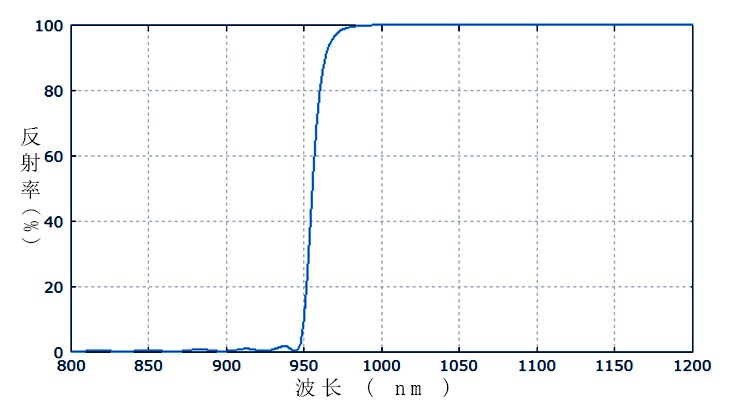
Figure 2: Reflectance spectra of a dichroic mirror coating, designed with a software RP coating, with high transmittance (low reflectivity) around 800–950 nm and of course high reflectivity at 1064 nm.
Current Phenomena:
For any dielectric mirror, the reflection spectrum (reflectance vs. wavelength) depends on the angle of incidence and (illegal incidence) also on the polarization of the input light. To a limited extent, mirror designs can be carried out to achieve the desired dichroic characteristics over certain input angle ranges.
Since the dichroic mirror must be transparent to at least one wavelength of interest, the quality of the substrate material (e.g., transmission loss) and reflection from the back side need to be considered. The backside of the backside on an anti-reflective coating can help reduce this reflection, and the slight wedge-shaped form of the substrate can often eliminate the effects of residual reflections.
Be the first to comment