
A Q-switched laser is a type of laser that uses either active Q-switched technology or passive Q-switched technology so that it emits high-energy light pulses. Typical applications for this type of laser are laser material processing (e.g., cutting, drilling, laser marking), pumping nonlinear frequency conversion devices, ranging, and remote sensing。
Q-switched lasers can be continuously pumped or pulsed, e.g. from flash lamps (especially for low pulse repetition rates). For continuous pumping, the laser gain medium should have a long up-level lifetime to achieve a sufficiently high stored energy rather than losing energy as in fluorescence. In any case, the saturation energy should not be too low, as this can lead to excessive gain (due to high gain efficiency) and thus more difficult to suppress the laser that appears prematurely. On the other hand, too high a saturation energy can make effective energy extraction difficult.
Types of Q-switched lasers
The most common type is the active Q-switched solid-state laser, where the solid-state gain medium is ideal for storing excitation energy for a sufficiently long period of time, and bulk lasers allow for a large mode area (and therefore higher pulse energy and peak power) and a shorter laser resonator (compared to fiber lasers). The resonator contains an active Q-switch – an optical modulator that, in most cases, is an acousto-optic Q-switch.
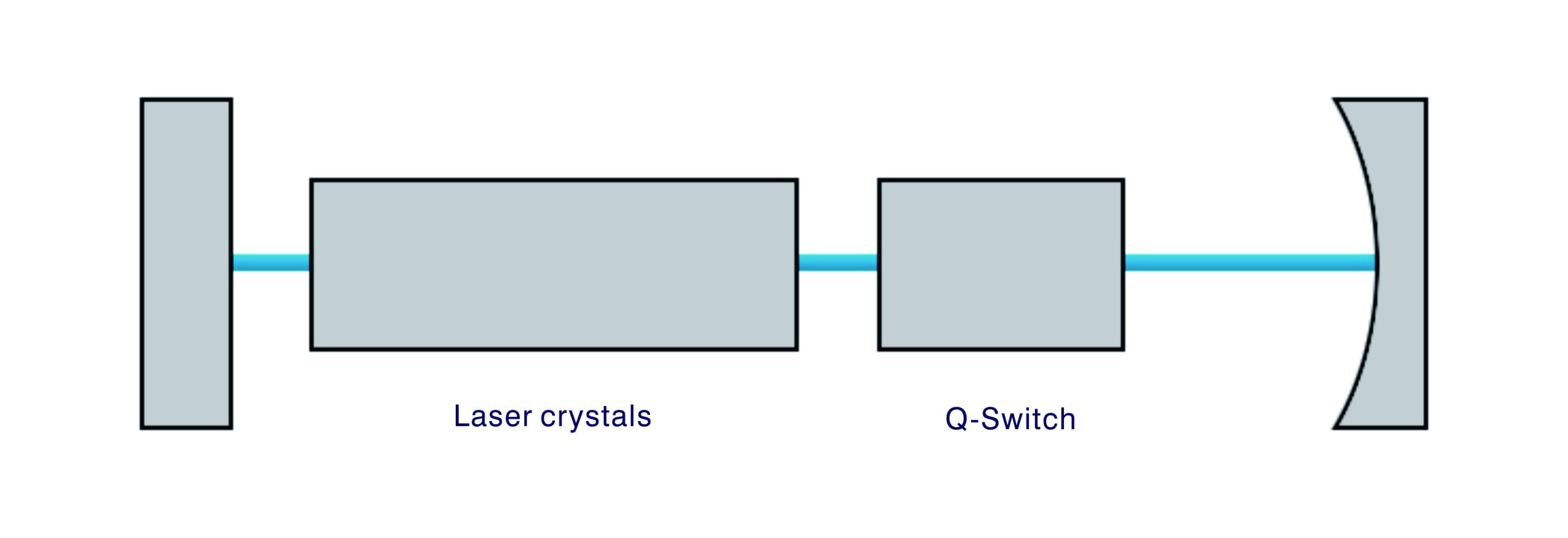
For emission wavelengths in the 1 μm spectral region, the most common pulsed lasers are based on neodymium-doped laser crystals such as Nd:YAG, Nd:YVO4, or Nd:YLF, and ytterbium-doped laser gain media can also be used. A small active Q-switched solid-state laser can emit an average power of 100 mW at 1 kHz repetition rate and 100 μJ pulse energy in a 10ns pulse, followed by a peak power of about 9 kW. At low pulse repetition rates (below the inverse upper-state lifetime), the highest pulse energy and shortest pulse duration are obtained, but the average output power is reduced. Nd:YAG lasers with slightly larger 10W pump sources (e.g. diode rods) can reach pulse energies of a few millijoules. Nd:YVO4 is particularly suitable for short pulse durations and high pulse repetition rates, or for operation with low pump power.
Q-switched lasers with longer emission wavelengths are typically based on erbium-doped laser gain media, such as Er:YAG at 1.65 or 2.94 microns, or thulium-doped crystals at about 2 microns.
Significantly larger pulse energies can be obtained from the amplifier system (MOPA), and for high average power and medium pulse energies, fiber optic MOPA, also known as MOFA, can be used.
Especially for low pulse repetition rates, lamp pumping may be a more economical option, as discharge lamps are much cheaper than laser diodes for a given peak power. However, for higher powers, diode pumping becomes more valuable due to the greatly reduced thermal effects in the laser crystal.

Passive Q-switched lasers contain a saturable absorber (passive Q-switch) instead of a modulator. In continuous pumping, a regular pulse train can be obtained, where the pulse repetition rate increases with the pumping power. The timing of the pulse is usually not precisely controlled by external means. The most commonly saturable absorber used for 1 μm lasers is a Cr:YAG crystal.
Passive Q-switched microchip lasers have a particularly compact design, typically emitting pulses with energies between nanojoules and a few microjoules, an average output power of tens of milliwatts, and repetition rates between a few kilohertz and a few megahertz.
In general, the average output power of passive Q-switched lasers is more limited than that of active Q-switched lasers because the saturable absorber dissipates some of the energy. Note that saturable absorbers typically have some unsaturated losses, which often increase the energy dissipated far beyond the unavoidable level in theory.
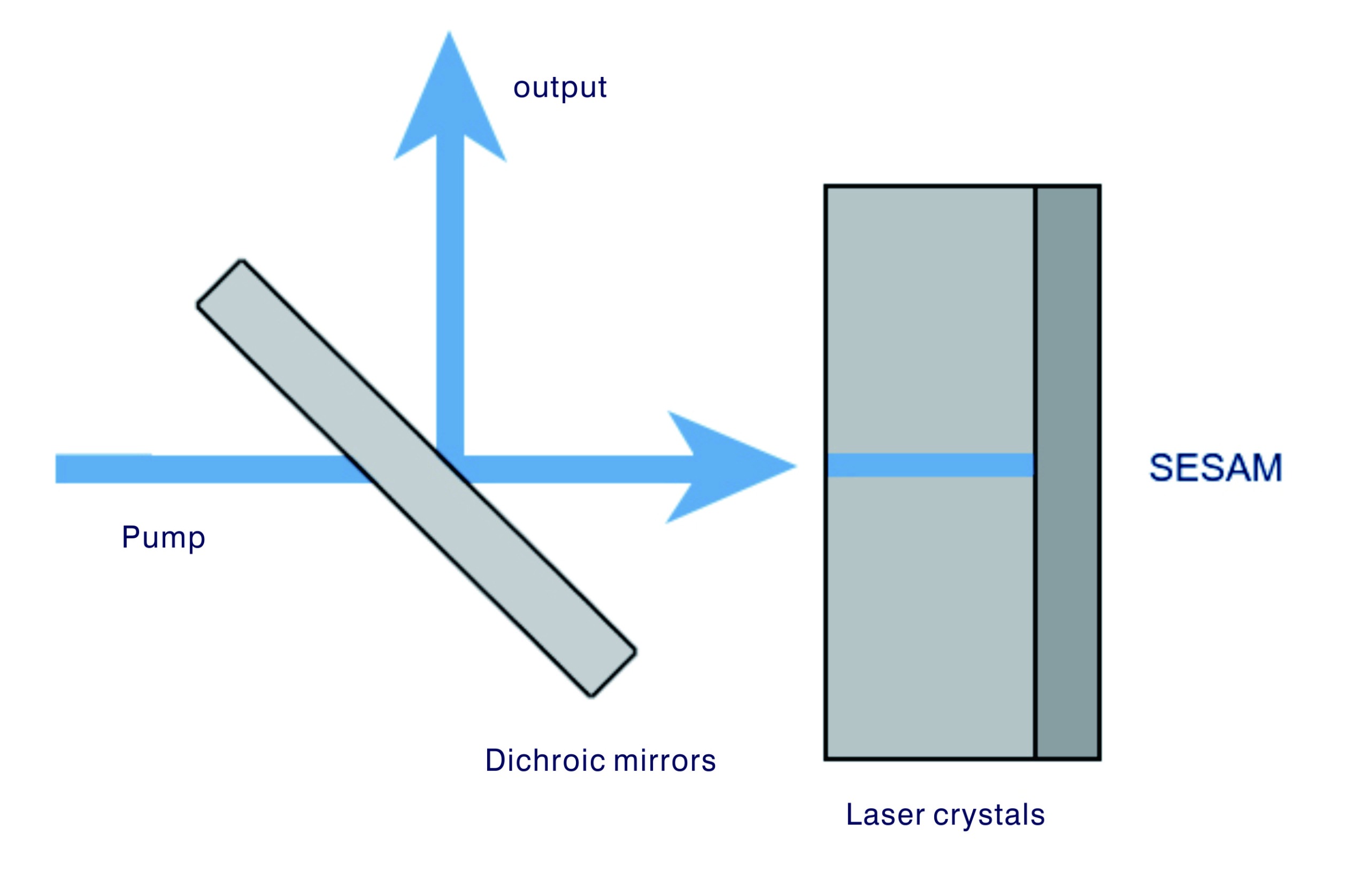
Fiber lasers can also be actively or passively Q-switched. However, all-fiber devices are quite limited in terms of performance, and Q-switched fiber lasers that incorporate linear optical elements (acousto-optic Q-switching) are not as robust and powerful as linear lasers. The relatively small mode area introduces problems with fiber nonlinearity and laser-induced damage, which limits pulse energy, especially achievable peak power. Note: The typically very high laser gain in fiber lasers has an important impact on laser dynamics; In particular, it can lead to the formation of complex temporal substructures.
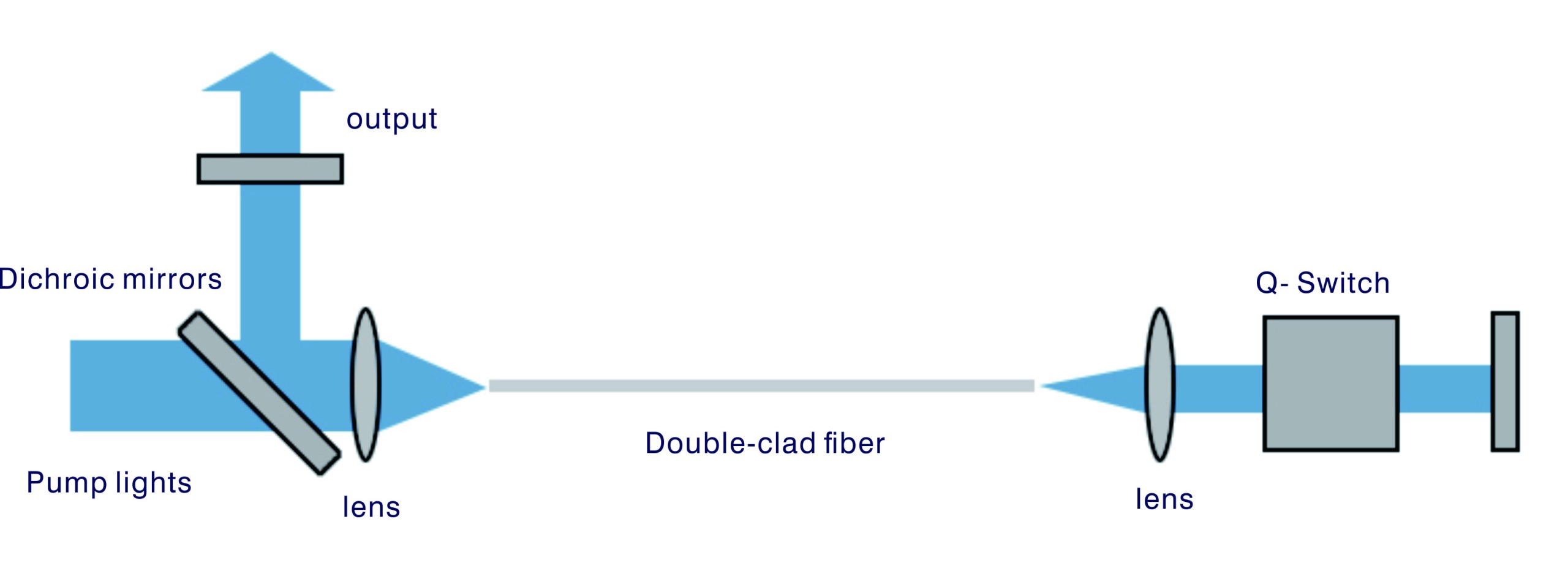
On the other hand, high-power fiber amplifiers are suitable for amplifying pulse trains with high average power but moderate pulse energy. In such amplifiers, some degree of nonlinear pulse distortion is generally acceptable for the application.
Applications of Q-switched lasers
Q-switched lasers have a wide range of applications. Some examples:
- Laser material processing, such as laser cutting, laser drilling, laser marking, laser pattern making;
- Laser rangefinder;
- 3D imaging lidar;
- Laser-induced breakdown spectroscopy;
- Medical applications such as dermatology and tattoo removal;
- Pumping devices for nonlinear frequency conversion, e.g. pulsed optical parametric oscillators;
- Fluorescence spectroscopy;
Laser safe
Note that the high pulse energy and peak power of lasers with low average output power can cause serious laser safety concerns. In many cases, direct access to the eye can lead to blindness, even for Q-switched lasers operating in the "eye-safe" spectral region, and precautions should be taken accordingly.
Be the first to comment