
A mode-locked laser is a type of laser that applies active or passive mode-locking technology to emit periodic ultrashort pulse trains. Due to the bandwidth of ultrashort pulses, short-pulse mode-locked lasers, especially in the sub-picosecond region, require a large gain bandwidth of the laser gain medium. Other required characteristics were low nonlinearity and dispersion, as well as (especially for passive mode-locking) a high enough laser cross-section to avoid Q-switch instability.
Types of mode-locked lasers
- In the 70s of the 20th century, dye lasers were widely used, pumped with argon ion lasers. Dye lasers have a wide gain bandwidth and can produce very short pulses. However, dye lasers have been replaced by most solid-state lasers when they are able to provide similar or better performance.
- Solid block lasers based on doped insulator crystals or glass are the most dominant type of mode-locked lasers today. They can achieve very short pulses, very high pulse energy and average output power, high (or low) pulse repetition rates, and high pulse quality.
- Fiber lasers can also be pattern-locked to produce very short pulses, and their equipment is generally inexpensive. High output power is usually not achieved directly, but through the use of fiber amplifiers. The pulse duration of ultrafast fiber lasers is often limited by nonlinear or higher-order dispersion rather than the gain bandwidth.
- Diode lasers can be manufactured into mode-locked diode lasers, which are mainly used in fiber optic communications. Recently, optically pumped passively mode-locked VECSELs have been shown to be comparable to other solid-state lasers, especially when relatively high output power, multi-gigahertz pulse repetition rates, and short pulse durations (a few picoseconds or less) are required.
Since the characteristics of these laser gain media are very different, it is critical to select a suitable medium to allow the mode-locked laser to operate within a specific range of parameters.

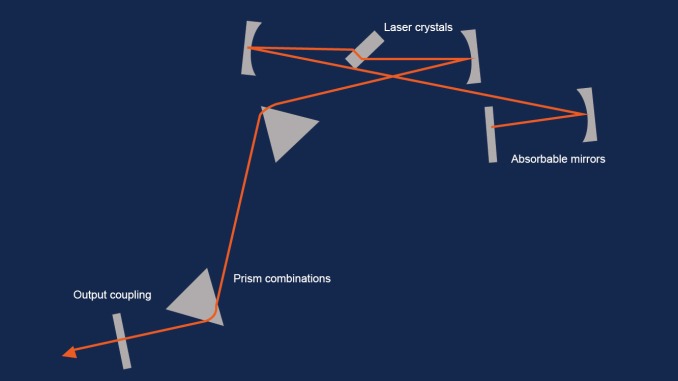
Resonator structure of a typical femtosecond mode-locked solid-state laser with low to medium output power, the gain medium can be made of crystal or glass. Prism pairs are used for dispersion compensation, and passive mode-locking is achieved by SESAM.
Some special advantages
Some of the special achievements of passive mode-locked solid-state lasers are:
- The shortest pulses lasting less than 10 fs (pulses of several cycles) are usually achieved by mode clamping of the KLM lens of Ti:Sapphire lasers.
- In sub-picosecond pulses, passive mode-locked thin disk lasers have an average output power of more than 200 W and pulse energies of more than 10 μJ, and even 80 μJ in picosecond pulses.
- Both passively mode-locked miniature lasers and harmonic-mode-locked fiber lasers have achieved high pulse repetition rates, which can even reach >1THz or even higher with small laser diodes.
- Various lasers, often with high pulse repetition rates, have achieved quantum-limited time-jitter performance, outperforming many high-quality electron oscillators.
- Micro Er:Yb:glass laser structure for 50 GHz pulse repetition rate. The cavity length is only 3 mm (from the output coupler to the SESAM), and the modified settings can even reach 100 GHz.
Cavity emptying technique
By adding a cavity inverter to the laser resonator, mode-locked lasers can generate higher pulse energies, obtaining a few microjoules of energy at a lower pulse repetition rate (100 kHz or 1 MHz). The basic principle is to form a high-energy pulse within the resonator with low resonator losses, and then couple the output energy through the cavity pourer.
Applications of mode-locked lasers
- Short pulses can be measured with time-resolved techniques, such as electro-optical sampling measurements for integrated electronic circuits, or pump probes for semiconductor devices such as SESAM.
- Various imaging methods, laser microscopy, and laser spectroscopy benefit greatly from short pulses for a variety of reasons. For example, the high peak power of femtosecond lasers can be used for two-photon absorption fluorescence microscopy to achieve very high spatial resolution in all three dimensions.
- In the field of optical metrology, mode-locked lasers can be used for distance measurement, but they can also be used for frequency metrology (time holding) and other fields. When it comes to frequency metrology, the frequency comb of mode-locked lasers plays a particularly important role.
- The high peak power of mode-locked lasers greatly facilitates many of the processes of nonlinear frequency conversion, even if the average power remains moderate.
- Other areas with great potential are microwave, millimeter-wave and terahertz optics, as well as picosecond optoelectronics.
- Mode lasers are also often used in combination with ultrafast amplifiers to obtain higher average power, especially higher pulse energies and peak powers. This amplification system can meet more additional applications.
- High pulse intensity can be used for laser material processing applications such as laser micromachining, laser surface modification, drilling, and 3D laser prototyping.
- In the medical field, mode-locked lasers can be used again for the processing of a material, for example, as a laser scalpel or in ophthalmology (e.g. for vision correction). There are also some photochemical effects, such as those used for certain skin treatments.
- High-power laser projection displays can be achieved with mode-locked lasers and frequency conversion stages, the latter of which is typically much simpler when using ultrashort pulses.
Be the first to comment